
Experienced Attorneys. Proven Results.
Hire the Team That Knows How To Win and Maximize the Value of Your Case



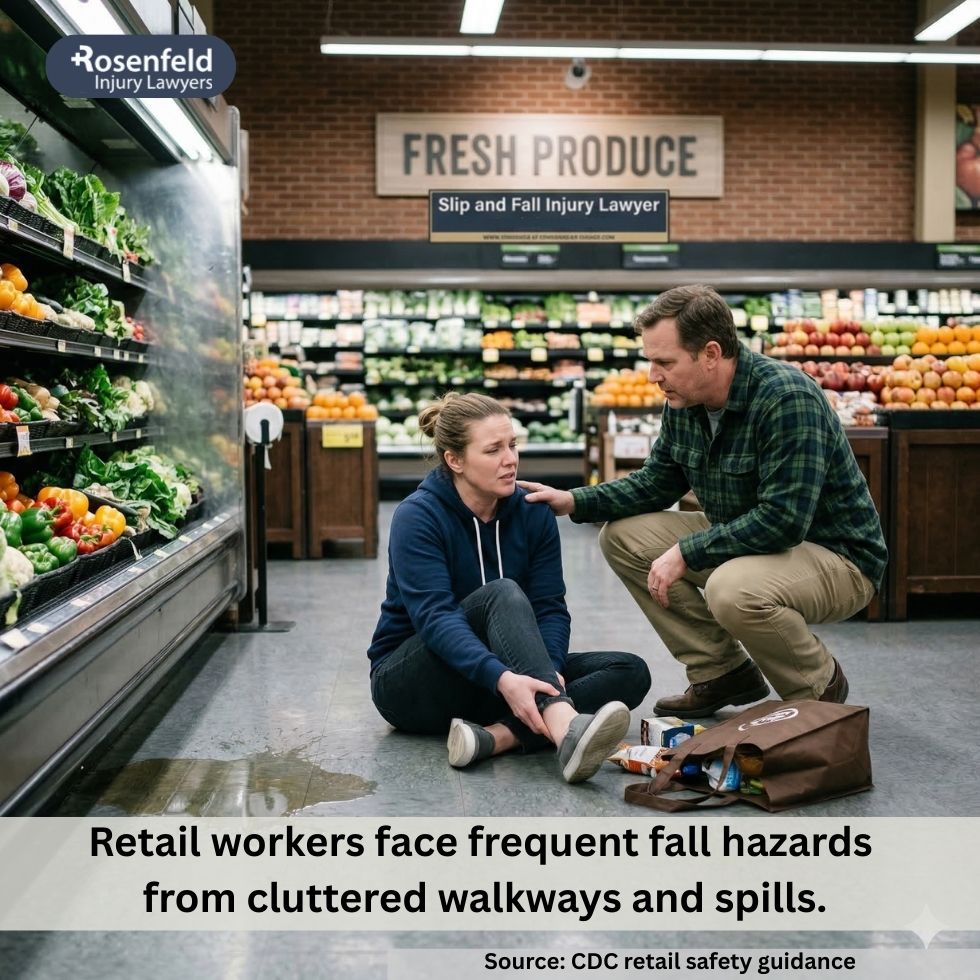
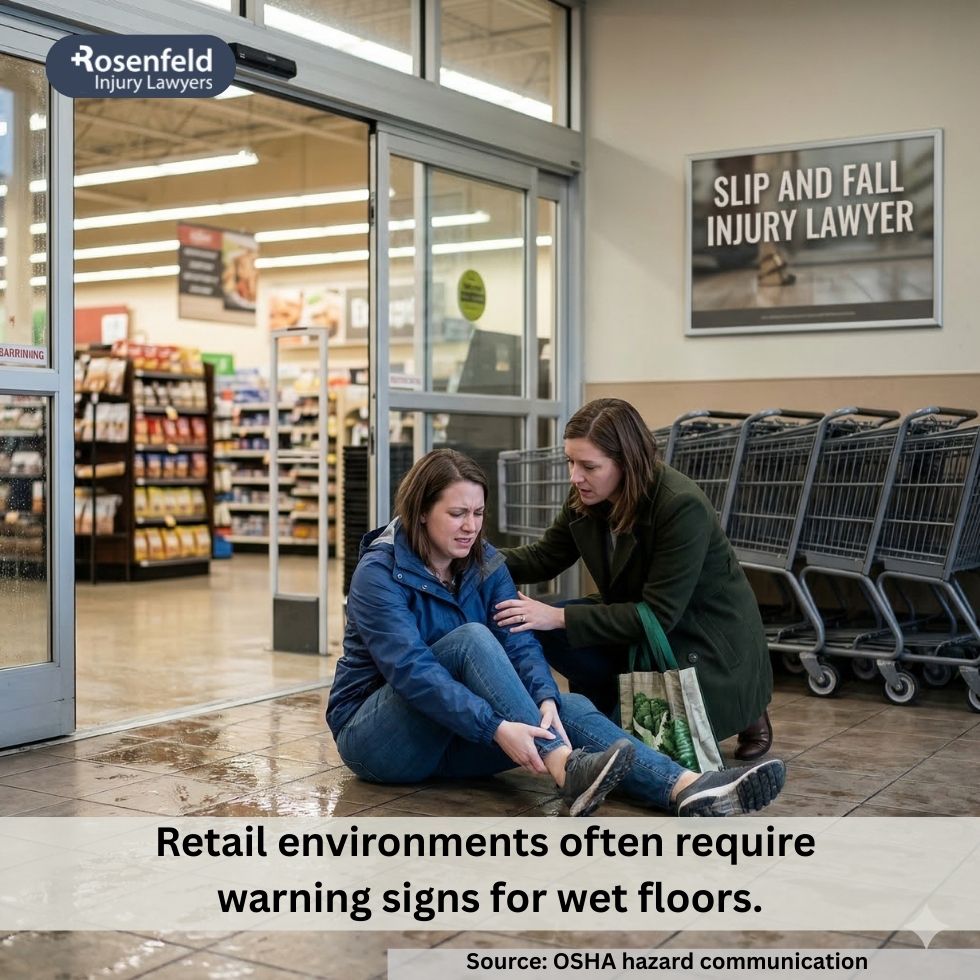
Slip and fall incidents in retail stores are more common than many people think, especially in busy shopping areas like Chicago. These accidents often happen due to wet or freshly mopped floors, spilled liquids, cluttered aisles, poor lighting, or a lack of proper warning signs. In fact, retail environments account for a significant portion of slip, trip, and fall injuries each year, many of which could be prevented with proper safety measures.
If you’ve been injured in such an incident, a store slip and fall lawyer Chicago can help you understand your rights and pursue fair compensation. A slip and fall in a store, such as a retail store along Milwaukee Avenue, can lead to significant injury and high expenses. Our experienced personal injury lawyers will hold property owners accountable through a premises liability claim, ensuring you receive maximum compensation. Contact us today for a free consultation about the legal process.

$1,500,000: Miles fell down a staircase that did not adhere to Chicago building codes. We proved that the slip and fall accident was due to this negligence.
$1,200,000: Maya slipped and fell on spilled food in a Chicago store, breaking her arm. We proved that the store owner’s negligent cleaning schedules caused the accident.
$835,100: Samantha fell down a poorly maintained staircase in a Chicago property. We held the property owners accountable for their negligent maintenance.
With a 98% success rate, our experienced personal injury attorneys in Chicago have recovered fair compensation for over 5,000 clients in the past 25 years. Our firm has secured more than $490 million in settlements for injured victims, including cases involving negligent property and business owners in slip and fall accident claims, premises liability cases, and store injury lawsuits.
Recognized for excellence, we hold a 10/10 AVVO rating and are proud members of the Million Dollar Advocates Forum—reflecting our commitment to maximizing compensation, legal expertise, and continuous excellence in personal injury law.
Potential hazards found in retail stores, department stores, shopping malls, and grocery stores include the following.
Trip and fall incidents can lead to serious injuries and expensive medical treatment. Common injuries include:
Our team will fight hard to secure compensation from the store’s insurance company, ensuring that store owners are held responsible for failing to maintain safe premises. You may receive both economic and non-economic damages, including the following.
Using your medical records and expenses, we can recover compensation for the following:
Our attorneys will speak to medical professionals who can help us evaluate what future needs you may have.
Your personal injury claim can compensate you for your lost wages and any loss of income due to permanent disability. If this is a wrongful death case, we will help the family recover compensation for their loved one’s future earnings.
Slip and fall victims often deal with severe pain and social limitations due to their injuries. Compensation we can secure for the injured party includes:
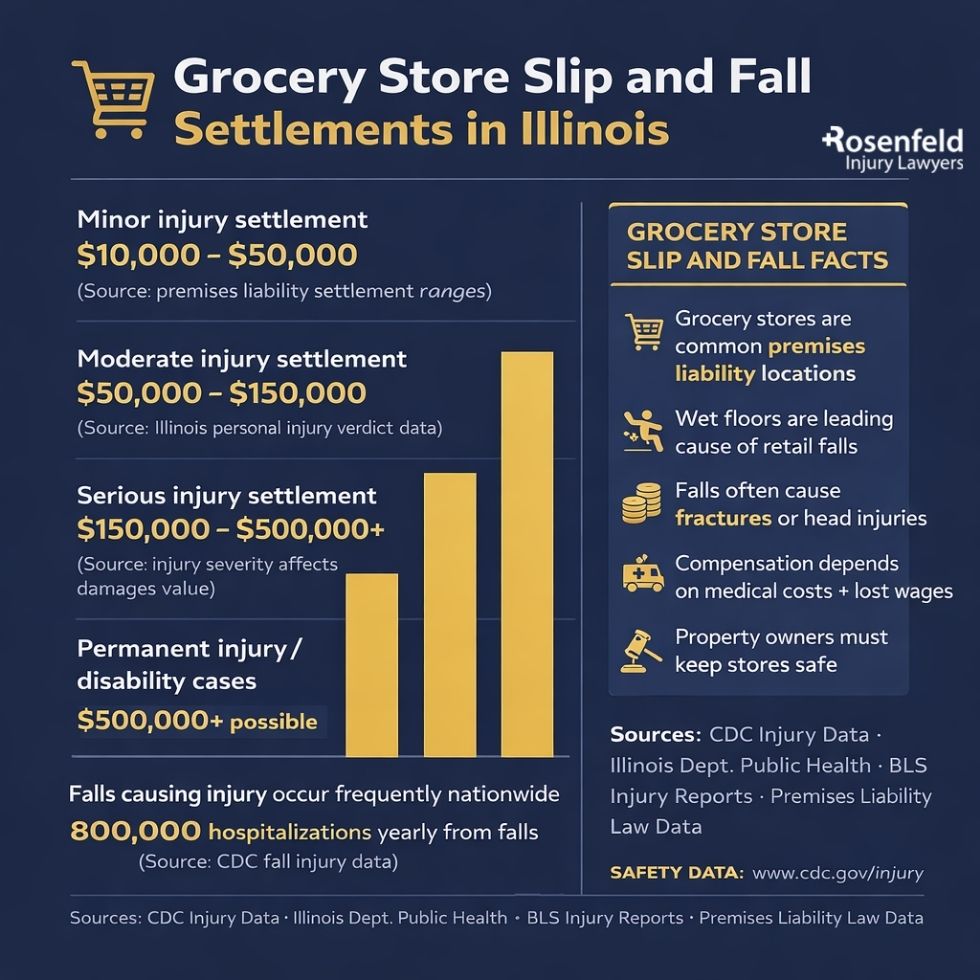
The average slip and fall settlement in Chicago is $377,915, with a median settlement of $128,300. Your settlement will depend on the strength of the evidence, your overall expenses, the applicable insurance policy, and whether you have a skilled attorney.
Anne Marie Davidson was exiting the Park West Hair Salon on Lincoln Ave. in Chicago when she pulled on a broken door handle. It came off in her hand, leading her to fall and break her hip. She required three surgeries and 10 months of physical therapy to recover. Her attorneys were able to prove negligence and secure her $300,000.00.
Constance Kusar, 72, was shopping at CVS Pharmacy in Belvidere when she slipped in the icy parking lot. Kusar suffered a fractured wrist, which required multiple surgeries and left her with lasting pain. The defendants agreed to settle out of court for $645,000.00.
Slip and fall accident cases can be complex because store owners and property managers often deny responsibility, claiming they had no notice of the hazardous condition. In many premises liability cases in Chicago, critical evidence such as surveillance footage, incident reports, and maintenance records may be withheld or delayed, making it harder for victims to prove negligence.
Additionally, corporate insurance companies have experienced legal teams whose primary goal is to minimize payouts and deny valid claims in slip and fall injury cases.
With extensive experience handling cases in the Circuit Court of Cook County, our Chicago slip and fall lawyers understand Illinois premises liability laws and know how to build strong claims, negotiate effectively with insurers, and ensure all legal documents are filed properly to pursue maximum compensation.
Contact us now for a free consultation
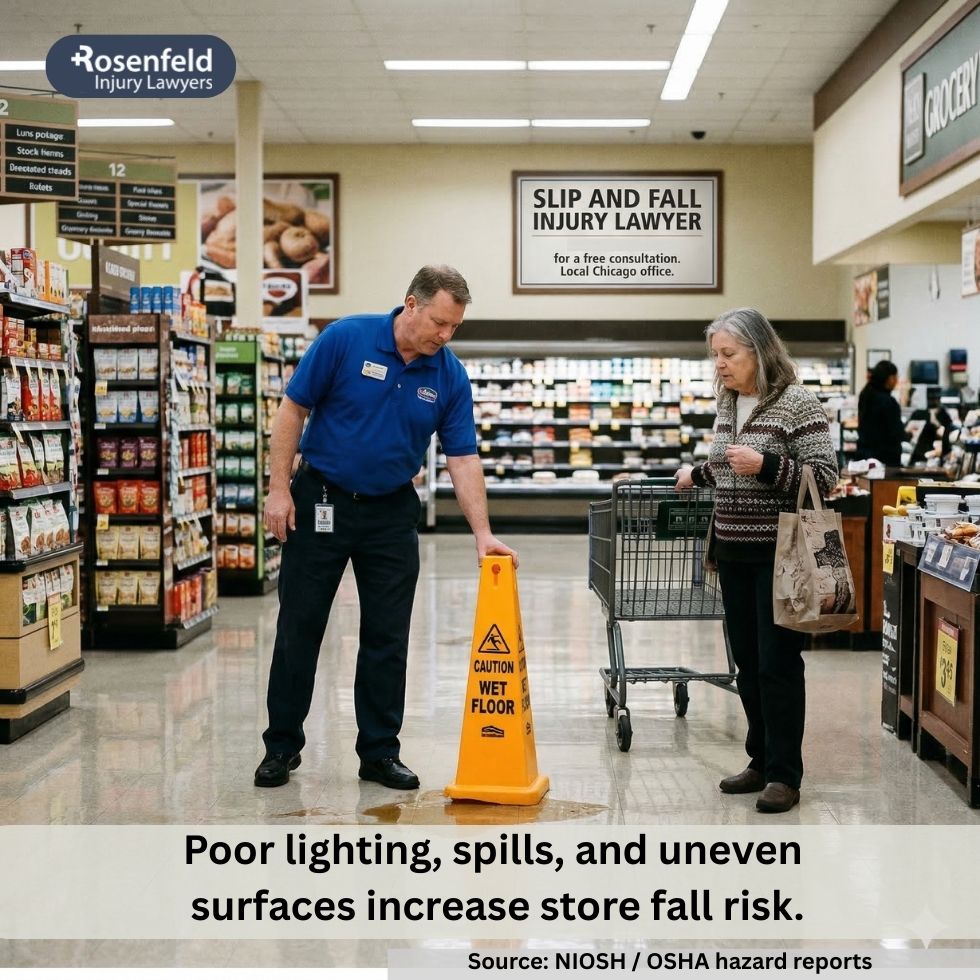
Slip and fall accidents at stores are among the most common causes of premises liability claims in Chicago, often occurring in supermarkets, retail outlets, and shopping centers. These incidents frequently result from wet floors, spilled products, poor lighting, or unsafe walking surfaces
While these accidents can happen anywhere, they are more common in certain locations, including the following.
A typical Chicago slip and fall case follows a structured legal process. It begins with a free consultation where we evaluate your claim and determine liability under Illinois premises liability law.
Next, our attorneys conduct a detailed investigation, gather evidence, and calculate damages. We then send a demand letter to the insurance company and begin settlement negotiations. If a fair resolution is not reached, the case may proceed to filing in the Circuit Court of Cook County, followed by discovery and potentially trial. Most slip and fall injury cases are resolved through negotiation, but we are always prepared for litigation when necessary.
The Illinois Premises Liability Act requires property owners to take reasonable precautions for a safe environment and to warn visitors about potential hazards (740 ILCS 130/). To establish liability, we must demonstrate that the property owner owed you a duty of care. This means that you were legally allowed on the premises and that your actions were not the primary cause of the accident.
Property owners cannot be held liable for open and obvious dangers or those that occur due to natural circumstances. For example, the Illinois Supreme Court case Reed v. Galaxy Holdings found that a laundromat could not be held accountable for an accident that occurred due to wet floors caused by tracked-in mud. The court established that the laundromat had taken reasonable measures to prevent accidents by placing a floor mat down, and the floor mat slipping wasn’t their fault.
Local laws can also establish the store owner’s negligence. In Chicago, property owners are required to keep their stairs in good condition and secure all railings; they must also ensure that stair risers are the correct height and have adequate tread (13-196-570).
Lastly, Illinois uses comparative negligence to determine fault (735 ILCS 5/2-1116). Everyone involved in a lawsuit will be assigned a portion of the blame. If you are considered less than 50% responsible, you can claim compensation, but your percentage of blame will reduce your settlement.
Illinois has a two-year statute of limitations for personal injury cases (735 ILCS 5/13-202). You must file before this deadline if you want to receive compensation. Contact the best Chicago personal injury firm as soon as possible to ensure we can file in time.
Our attorneys can hold a variety of parties responsible for a premises liability claim, including the following individuals and organizations.
Store Owners: The company owner’s negligence may result from failing to supervise employees, to maintain the property, or to respond promptly to complaints.
Property Owners: Some retail store owners do not own the building, but lease it. In this instance, the landlord or property manager can be held accountable for failing to keep guests safe from dangerous conditions on the premises.
Property Managers: Maintenance companies or management firms may be responsible for maintenance deficiencies that caused the accident. For example, if you slipped on a cracked tile or threadbare rug, the management company should have identified this deficiency and fixed it.
Mall Operators: While malls are made of restaurants, retail stores, and other services, the store owner is not responsible for common areas; the mall operator must maintain these. If you were hurt outside of a store, such as tripping on the escalator at Water Tower Place, then you can sue the operator.
National Chains: Stores like Target, CVS, Walgreens, Home Depot, and PetSmart are required to maintain safe premises in all their locations, including promptly rectifying any issues that store managers bring to their attention.
Individuals: In some cases, you may have been hurt because of an individual, such as someone pushing past you in an aisle or hitting you with a cart. This individual could be party to the suit as well.
Manufacturers: While retail store managers and owners are typically responsible for all maintenance on their premises, in some cases, it is manufacturer defects that caused the problem. For example, if you slipped on linoleum tile, and it was proven that the linoleum had a manufacturing flaw that caused it to delaminate, the manufacturer could be held liable, too.
Insurance providers will do everything possible to reduce your compensation and keep their clients from being held liable. Our top-rated attorneys will skillfully counter these claims.
Lowball Offer: Insurers want to get your case with as soon as possible, so they may reach out immediately and offer a low sum. They are relying on the fact that most people don’t know how much a personal injury settlement is worth. Never speak to insurance without an attorney, and always allow us to look over settlement agreements before you sign anything.
Open and Obvious Hazardous Condition: The open and obvious doctrine means that anyone would have noticed the defect and taken precautions to avoid it. However, the insurance agency may insist that something is open and obvious when the average person would not have identified such a problem. We will demonstrate that the hazardous condition is not obvious.
Lack of Causation: This argument claims that your injuries were not caused by the accident but by something else, or that the cause of the accident was a trivial defect. This can be countered by showing surveillance footage of the accident, consulting with experts in accident reconstruction, and using maintenance records.
No Actual or Constructive Notice: To be held responsible under premises liability laws, the property owner must know of the problem and refuse to fix it. This could be actual notice, such as an employee reporting a spill, or constructive notice, meaning that if they were paying attention to their property, they would have identified the problem. Using maintenance records, private communications, or photos of the scene, we can demonstrate that the owner would have been aware if they were paying attention.
Distraction: The defendant’s insurance could argue that you were not paying adequate attention to your surroundings, and therefore, you are primarily liable for the accident. For example, you may have been talking on the phone, looking up at the ceiling, or chatting with a friend. We can subpoena the store for surveillance footage that will show what you were doing right before you fell and how this could not be counted as a distraction.
Proof of Warning Signs: A “wet floor” sign could serve as evidence that the property owner attempted to warn others of potential issues, and that ignoring the sign would be your fault. We can use witness statements, photos of the scene, surveillance footage, or accident reports to demonstrate that either there was no sign, or that it was an insufficient warning.
Comparative Negligence: As mentioned, Illinois uses comparative negligence to determine who can file a claim. If you are not more than 50% responsible, you can pursue compensation. However, the other party will insist that you were the primary cause of the accident. We will use evidence to show that while you may have contributed to the condition, your actions were not the primary issue.
Assumption of Risk: Stores will attempt to argue that you assumed the risk of injury by visiting their store. However, we will argue that your injuries are inconsistent with this argument, such as by proving that if the property were in good condition, this wouldn’t have happened.
Downplaying Injury Severity: Insurers will attempt to claim that you were not as badly injured as you state. They may prove this by putting you under surveillance and trying to show you engaging in everyday activities. Our slip and fall attorneys will use doctor testimony and medical records to show that your injuries are severe and directly caused by the incident.
Preexisting Conditions: In some cases, the insurer will not dispute that you were hurt, but they will argue that your injuries would not have been as severe if you didn’t have an underlying medical condition. For example, if you had hip replacement surgery before the incident, then they could claim that your balance was compromised. We can work with doctors and other healthcare professionals to dispute this.
Procedural Defenses: Insurers may stall for time by filing motions for extensions or argue that you did not file in time. Working with an excellent attorney will help you avoid these problems, as we will file your case on time and adhere to all procedural rules.
Your actions directly after the accident can make a significant difference in whether you secure compensation. Follow these steps as soon as possible.
Get Medical Treatment: Visit the closest emergency room, such as Northwestern Memorial Hospital, for a full exam after your slip and fall injury in a store or retail property. Immediate medical care also helps document your injuries for your Chicago slip and fall case.
Inform the Owner: Inform the store manager or owner of the accident and request an incident report. Make sure to get everything in writing, as this ensures that they cannot later deny notice in your store slip and fall claim in Chicago.
Gather Evidence: Secure photos and videos of the accident scene that will prove the circumstances surrounding your slip and fall accident in a retail store. Get contact information for witnesses, such as other guests or store workers. Write down dates, times, and locations, as well as a narrative of the event to support your premises liability case.
Preserve Your Footwear and Clothing: In many Chicago slip and fall injury claims, the defendant will argue that your footwear or clothing caused the fall, such as ballet flats or slippery shoes. A store slip and fall lawyer in Chicago can use your preserved footwear as important evidence.
Collect Information: Document your recovery through pictures and personal narratives. Gather information about your expenses, such as medical bills, lost wages, out-of-pocket treatment costs, transportation expenses, and other damages related to your slip and fall injury claim.Maintain Your Treatment Regimen: The defense may claim that you did not follow your prescribed treatment plan and therefore failed to mitigate damages in your premises liability lawsuit. It is important to follow your doctor’s instructions, including physical therapy and ongoing medical care.
Do Not Speak to Insurance Agents: Insurance adjusters will try to reduce your slip and fall settlement in Chicago by minimizing your injuries or shifting blame. They may also request statements or monitor your activities. Never speak to insurers or third parties without your attorney present.
Talk to a Lawyer: Contact an experienced Chicago slip and fall lawyer for a legal consultation. We will evaluate your premises liability claim, identify liable parties, and pursue maximum compensation for your injuries and losses.
Our experienced Chicago slip and fall lawyers assist you with every stage of your personal injury and premises liability claim, from initial investigation to final settlement. We carefully review the details of your accident, gather crucial evidence such as surveillance footage, witness statements, and maintenance records, and identify all liable parties. Our legal team also handles communication with insurance companies to protect you from lowball settlement offers.
Case Evaluation: First, we will determine whether you have a valid premises liability case under Illinois law and how much you may be able to receive based on your expenses. We will use settlement calculators to identify your non-economic damages, like pain and suffering or emotional distress.
Establishing Liability: Using case precedent, local laws, case law, evidence, and expert testimony, we can prove who is liable and why.
Communicating With Third Parties: Our team will handle communications with insurance agents, landlords, managers, and other witnesses so that you can focus on recovery. This also ensures that you do not accidentally damage your case by claiming fault or accepting a lowball settlement.
Preserving Evidence: Evidence may quickly disappear, either due to the property owner attempting to cover up their liability or simple misplacement. Additionally, key witnesses may forget important information as time passes. We will preserve incident reports, maintenance records, surveillance footage, photos and videos, and physical evidence.
Filing Paperwork: Our top-rated legal experts will file the correct complaints with the Circuit Court of Cook County and write a demand letter for the insurance carrier, explaining what damages you should receive and why.
Negotiating with Insurance: Working with an attorney can ensure you receive maximum compensation, as we are familiar with insurance tactics and what a case like yours is worth. Through our aggressive negotiation, we push for a fair settlement that covers both current expenses and future needs.
Trial Representation: Many premises liability cases settle out of court because lawsuits are expensive and time-consuming. However, sometimes it’s necessary to file a lawsuit and take your case before a judge and jury. We will handle this entire process, including communicating with the other parties, sharing evidence, filing motions, and sharing your story with a judge and jury.
Our team works on a contingency fee basis, meaning you owe us nothing unless we secure compensation.
Any invitee can make a premises liability claim if they can prove the store owner’s negligence. This includes shoppers, customers, vendors, third-party contractors, and guests.
After a slip and fall accident, seek medical attention immediately, report the incident to the store manager, and document the scene with photos and witness details. Contact a Chicago slip and fall lawyer as soon as possible to protect your rights and preserve evidence.
To prove liability in a premises liability case, you must show that the store owner knew or should have known about the hazardous condition and failed to fix it or warn customers in time.
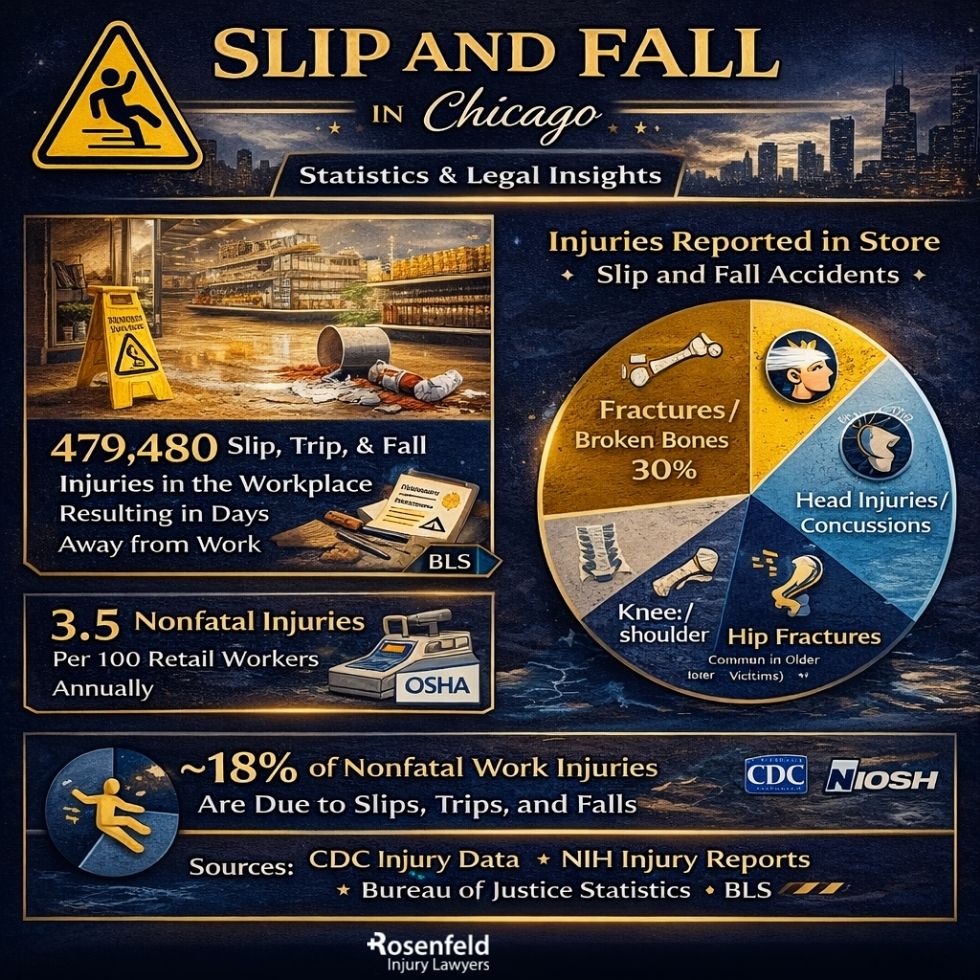
Common injuries include fractures, head injuries, spinal cord injuries, sprains, and back injuries. These injuries can lead to high medical costs and long recovery periods in slip and fall accident claims.
In Illinois, the statute of limitations for most slip and fall injury cases is generally two years from the date of the accident, making it important to consult a lawyer as soon as possible.
Victims may recover compensation for medical expenses, lost wages, pain and suffering, and future treatment costs through a store slip and fall claim in Chicago.
Our skilled slip and fall attorneys work on a contingency fee basis, ensuring you owe us nothing unless we earn you compensation. We have a 98% success rate and are a Super Lawyers-rated law firm. To speak to a top-rated attorney about your slip and fall accident, call us for a complimentary consultation.
 Legally Reviewed By
Attorney Jonathan Rosenfeld
The information on this page has been legally reviewed by Attorney Jonathan Rosenfeld, founder and managing partner of Rosenfeld Injury Lawyers LLC, a Chicago-based personal injury law firm. With decades of experience representing individuals injured in slip and fall accidents and other premises liability cases throughout Chicago, Mr. Rosenfeld is dedicated to protecting the rights of injury victims and helping them pursue the maximum compensation available under the law. His extensive legal knowledge and commitment to client advocacy ensure that the information provided is accurate, reliable, and aligned with current legal standards.