
Experienced Attorneys. Proven Results.
Hire the Team That Knows How To Win and Maximize the Value of Your Case



Clients frequently ask our attorneys, “How long does a slip and fall settlement take?” While there are general slip and fall settlement timeline expectations, every claim depends on factors such as the available evidence, injury severity, and the at-fault parties.
Whether you were injured on icy steps along the Chicago River or fell down a staircase in a Wrigleyville apartment, our experienced attorneys can help you understand slip and fall settlement timeline. This can help you set realistic expectations and move the process forward through strategic negotiations. Contact us today for a free consultation about your slip and fall case.

Before getting started on your claim, you must seek medical treatment, gather evidence at the accident scene, and file a police report if necessary. This will document your case and make it easier to seek compensation.
Your slip and fall settlement timeline starts as soon as you consult with a personal injury attorney. This slip and fall settlement process involves filing the claim, receiving a response from the insurance company, establishing liability, and potentially filing a slip and fall lawsuit.
To begin, you will file an insurance claim with the property owner’s insurance company. This is not the same as a lawsuit, which starts by filing a complaint with the proper court.
You’ll need to ask the property owner for their contact details and policy number. Every insurer has a slightly different claims process, but most will request basic details like your contact information, the property owner’s name, a summary of the accident, and evidence of your expenses, including medical bills and lost wages.
The insurance company will begin investigating your case and identify any policy exclusions that may result in your claim being denied. Insurance adjusters will review your medical expenses, determine liability, and identify the responsible parties. This process can take a few weeks, but insurance companies must respond within 60 days or explain the reason for the delay (Part 919.80(b)(3)).
If the insurance company refuses to offer a fair slip and fall settlement, then our attorneys will proceed to the next step.
A demand letter for a slip and fall claim informs the insurance company of what we believe is fair compensation based on your medical costs, lost wages, and pain and suffering. Working with a skilled attorney can significantly affect whether you receive a fair settlement agreement, as we are highly familiar with what would be appropriate compensation in a slip and fall case like yours.
Once the insurance company receives the demand letter, procedure for settlement negotiations can begin. The company will return with a counteroffer, and we will decide whether this is a fair settlement. If not, settlement negotiations continue until you are satisfied or until the insurance company refuses to continue negotiating.
Our law firm will file legal documents with the appropriate court, such as the Circuit Court of Cook County. The responsible parties and their insurance agents will receive a summons. The court schedules the trial, and we begin pre-trial proceedings, such as taking depositions from witnesses, filing motions to extend discovery dates, or requesting additional information from the other parties.
Many slip and fall cases settle before the trial date. You will sign a settlement agreement that outlines what the insurer is willing to pay you and states that you agree not to ask for more compensation later on.
Any outstanding bills, especially medical liens, will be the first thing covered by your slip and fall settlement. These will be paid directly to your health insurance provider or the medical provider.
Once all medical care has been covered, you will receive your settlement for things like lost income or pain and suffering.
Your attorney fees and other bills will be deducted from your settlement. You can either receive a lump sum payment or a structured settlement depending on your needs.
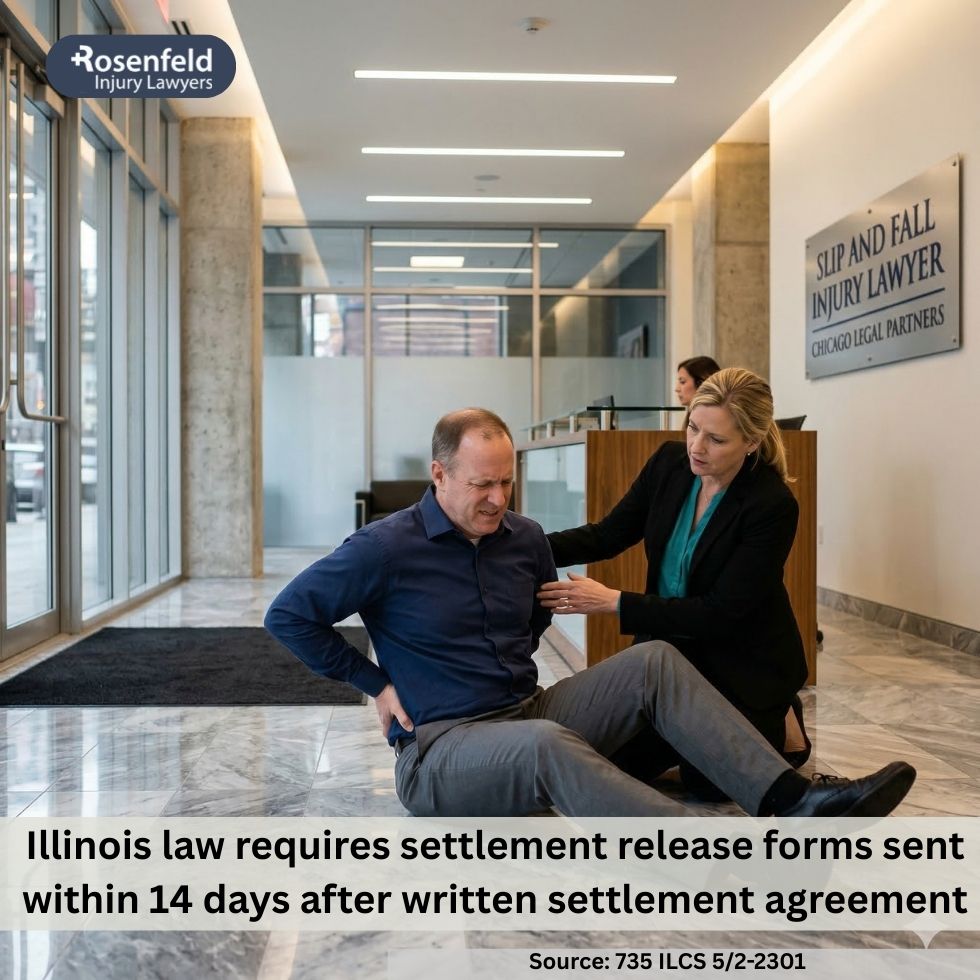
The slip and fall claim process can take anywhere from a few months to even years. Several factors determine the settlement timeline, including state law and how serious your slip and fall accident was.
Illinois has a two-year statute of limitations for personal injury claims (735 ILCS 5/13-202). In cases involving minors or disabled individuals, the statute of limitations is tolled, or paused, until they reach the age of majority or are capable of filing.
If you miss this deadline, you cannot file a slip and fall claim. Contact an experienced personal injury attorney as soon as possible to ensure we can begin negotiations.
Liability is the basis of a personal injury lawsuit, and it means that the other party was primarily responsible for your life-altering injuries. Illinois uses a comparative negligence doctrine, meaning that there can be multiple liable parties (735 ILCS 5/2-1116). You can seek compensation as long as you are not more than 50% responsible.
In some cases, there is unclear liability. One example is the Illinois Supreme Court case Murphy-Hylton v. Lieberman Management Services, where a property management company was held liable for a slip and fall case on an icy sidewalk.
Illinois shields property owners from liability for natural accumulation of ice (745 ILCS 75/2), but it was determined that the company was liable because the defective sidewalk made conditions more dangerous.
Yet, the Chicago Municipal Code mandates snow and ice removal (4-4-310 & 10-8-180). This shows the complex interplay between state and municipal ordinances, making it crucial that you work with a skilled attorney familiar with these nuances.
These more complex claims may need to be appealed in court if the verdict is unfavorable, which significantly increases the timeline.
Having detailed records of your injuries and testimony from medical professionals can help ensure that you receive maximum compensation. For example, you will need medical records, proof of lost income, photos of the accident scene, witness statements, maintenance records, and sometimes surveillance footage or expert testimony.
If the slip and fall accident occurred in a secluded area, such as an alleyway with no witnesses or surveillance footage, an experienced personal injury attorney will need to collect evidence to establish liability, prove that the accident occurred, and identify who was responsible.
In general, insurance companies and personal injury lawyers want to wait until you reach Maximum Medical Improvement (MMI) before starting settlement negotiations, as this ensures that your medical bills can be properly tabulated.
Slip and fall cases with more severe injuries will take longer to resolve because the victim requires ongoing medical care, and medical providers must determine what additional treatments they may need. Those with catastrophic injuries may have very high medical bills, and insurers will spend more time arguing about what treatments are necessary than those with moderate injuries.

Insurers will use any pre-existing medical conditions you have to argue that the slip and fall accident was not their fault. For example, if you have low vision and fall in the brightly lit Chicago Pedway, the insurer may claim that the accident would not have happened if you did not have that medical condition.
Our experienced attorneys will use your medical records and expert testimony to demonstrate that while your pre-existing medical conditions may have contributed to the slip and fall accident, they were not the primary cause.
The insurer’s willingness to negotiate plays a crucial role in your slip and fall settlement timeline. An insurance company that is aware it will likely lose in court may be more willing to settle quickly, while one that believes it has a strong legal argument may deny your claim or try to negotiate a lower settlement.
An experienced attorney will both set realistic expectations for how much you can recover and pursue the highest possible compensation based on the scope of your injuries and the available evidence. However, the more counteroffers we consider, the longer the settlement process.
Most slip and fall cases settle out of court. However, sometimes settlement negotiations fail, and we must file a slip and fall lawsuit. This increases the timeline because court dates are often scheduled months or even years in advance.
The trial process generally takes only a few weeks, but the pretrial proceedings can take a few months or longer. Our law firm must coordinate with both the court system and everyone involved in the case, particularly during the discovery process.
Discovery involves sharing all information we have gathered with all parties in the lawsuit so everyone can develop arguments based on the same evidence.
In cases involving complex liability issues or multiple parties, the process may take longer because we must coordinate with the court and the defendants.
Your experienced slip and fall lawyer will keep you updated on when you can expect to be compensated. While your specific timeline will vary, these are general guidelines for how long your case may take.
A Few Months (3-6 Months): This is more common for cases with clear liability and minor injuries. The settlement process is expensive and time-consuming for insurers, so they will offer to settle quickly.
Six Months to a Year: If you require ongoing medical treatment, such as physical therapy or multiple surgeries, insurers will want to wait until you reach maximum medical improvement before settling. This timeline may also apply if there is more than one liable party or insufficient evidence.
A Year or More: If you have to file a lawsuit or there are significant disputes about liability, then your case will take longer. This is also more common for more serious injuries where you require multiple surgeries, long-term care, or intensive therapy.
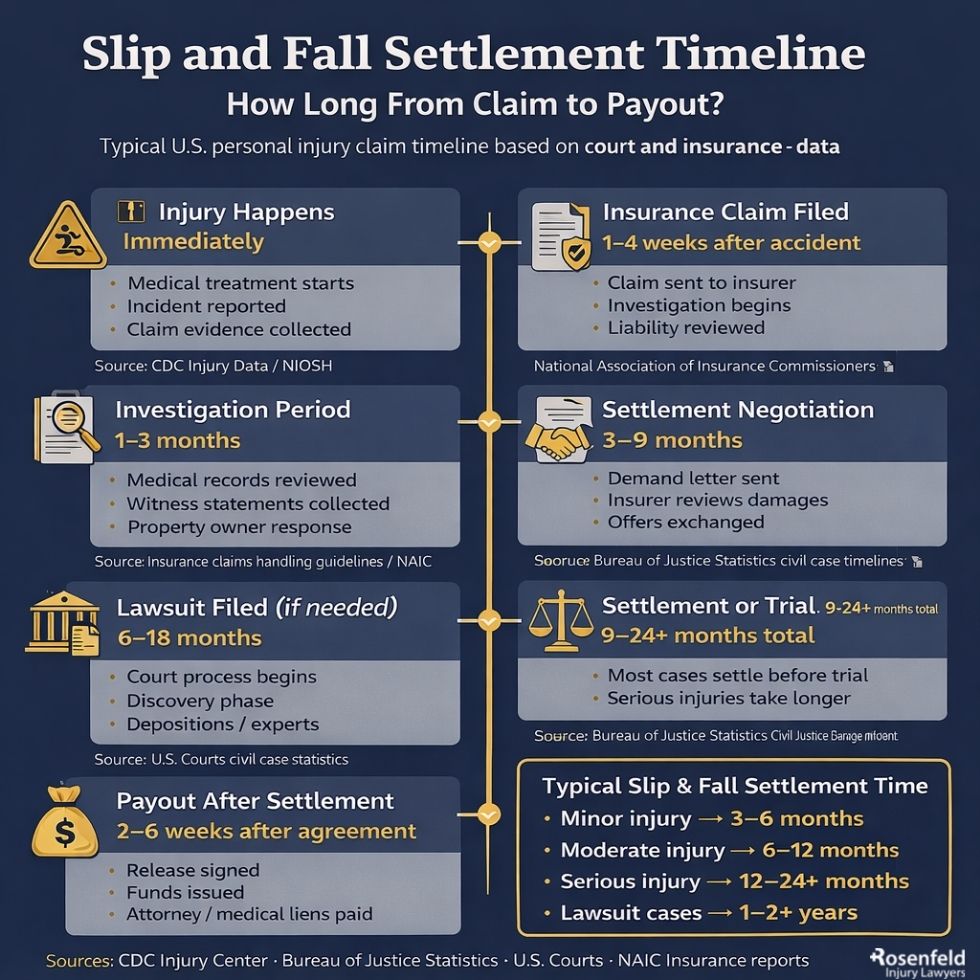
Our firm will set realistic expectations for how long does a slip and fall settlement take while giving you the best possible chance at fair compensation. We can assist you with the following aspects of your slip and fall claim.
How long does a slip and fall settlement take is highly case-specific, making it essential that you speak to a top-rated Chicago slip and fall attorney. Our firm is a member of the Million Dollar Advocates Forum and has a 10/10 AVVO rating, proving our skill in both negotiation and litigation.
We work on a contingency fee basis, meaning you owe us nothing unless we earn you compensation. Contact us today for a free consultation about your legal rights.
The timeline depends on factors such as injury severity, available evidence, insurance negotiations, and whether liability is disputed. Some cases settle in months, while others may take longer.
Settlement delays may occur due to disputes over liability, ongoing medical treatment, complex injuries, multiple parties, or lengthy insurance negotiations.
Yes, many slip and fall cases are resolved through settlement negotiations before reaching trial. However, filing a lawsuit may be necessary if the insurance company refuses fair compensation.
Evidence such as medical records, accident photos, witness statements, surveillance footage, and maintenance records can help establish liability and support your claim.
After reaching a settlement agreement, payment is typically processed after outstanding bills, medical liens, and attorney fees are resolved.
An experienced slip and fall attorney can help negotiate with insurance companies, prove liability, and pursue the maximum compensation available for your injuries.
 Legally Reviewed By
Attorney Jonathan Rosenfeld
The information on this page has been legally reviewed by Attorney Jonathan Rosenfeld, founder and managing partner of Rosenfeld Injury Lawyers LLC, a Chicago-based personal injury law firm. With decades of experience representing individuals injured in slip and fall accidents and other premises liability cases throughout Chicago, Mr. Rosenfeld is dedicated to protecting the rights of injury victims and helping them pursue the maximum compensation available under the law. His extensive legal knowledge and commitment to client advocacy ensure that the information provided is accurate, reliable, and aligned with current legal standards.