
Experienced Attorneys. Proven Results.
Hire the Team That Knows How To Win and Maximize the Value of Your Case



Stairway slip and fall accidents are a common cause of serious injuries in Chicago, often occurring in apartment buildings, offices, parking garages, and other public spaces. These incidents are typically caused by unsafe conditions such as broken steps, loose handrails, slippery surfaces, poor lighting, worn carpeting, or building code violations. When property owners fail to maintain safe stairways, victims can suffer severe injuries and may have grounds to seek compensation with the help of an experienced stairway slip and fall lawyer Chicago.
People often underestimate how dangerous staircases can be—until a serious injury occurs. At Slip & Fall Injury Lawyers, we represent individuals throughout Chicago who have suffered injuries from a slip and fall down stairs on someone else’s property. Our firm is ready to help you pursue full and fair compensation.
Our law firm has secured substantial slip and fall accident settlement amounts for injured victims across Chicago.
$1,500,000 — Harold, 78, suffered a fractured hip and spinal cord damage after falling down a poorly maintained stairwell at a North Side apartment complex. Our investigation revealed that the handrail was unstable and the stair treads were uneven—both violations of Chicago codes.
$835,100 — Marisol fell down an interior stairwell in her apartment building after slipping on worn carpeting and hitting her head on a metal railing. She suffered a traumatic brain injury and soft tissue damage to her back. The settlement reflected the long-term medical expenses and lost wages resulting from her serious condition.
$330,000 — Marcus was descending a stairway with poor lighting when he missed a step and fell. Our team uncovered multiple code violations and used expert testimony to prove that the stairway posed a dangerous condition. He suffered ligament tears and deep lacerations that required medical attention.
At Slip & Fall Injury Lawyers, our legal team is known for handling complex stairway slip and fall accident claims with skill and determination. Recognized by Super Lawyers and maintaining a 10/10 rating on Avvo, we’ve recovered more than $500 million in verdicts and settlements for injured victims.
Whether your case involves a stairway slip and fall accident in Chicago at a residential building, commercial property, or workplace, our experienced stairway slip and fall lawyers in Chicago are prepared to hold negligent property owners and insurance companies accountable. We understand the challenges involved in proving premises liability and are committed to helping victims pursue the compensation they deserve after suffering serious injuries caused by unsafe stairs and hazardous property conditions.
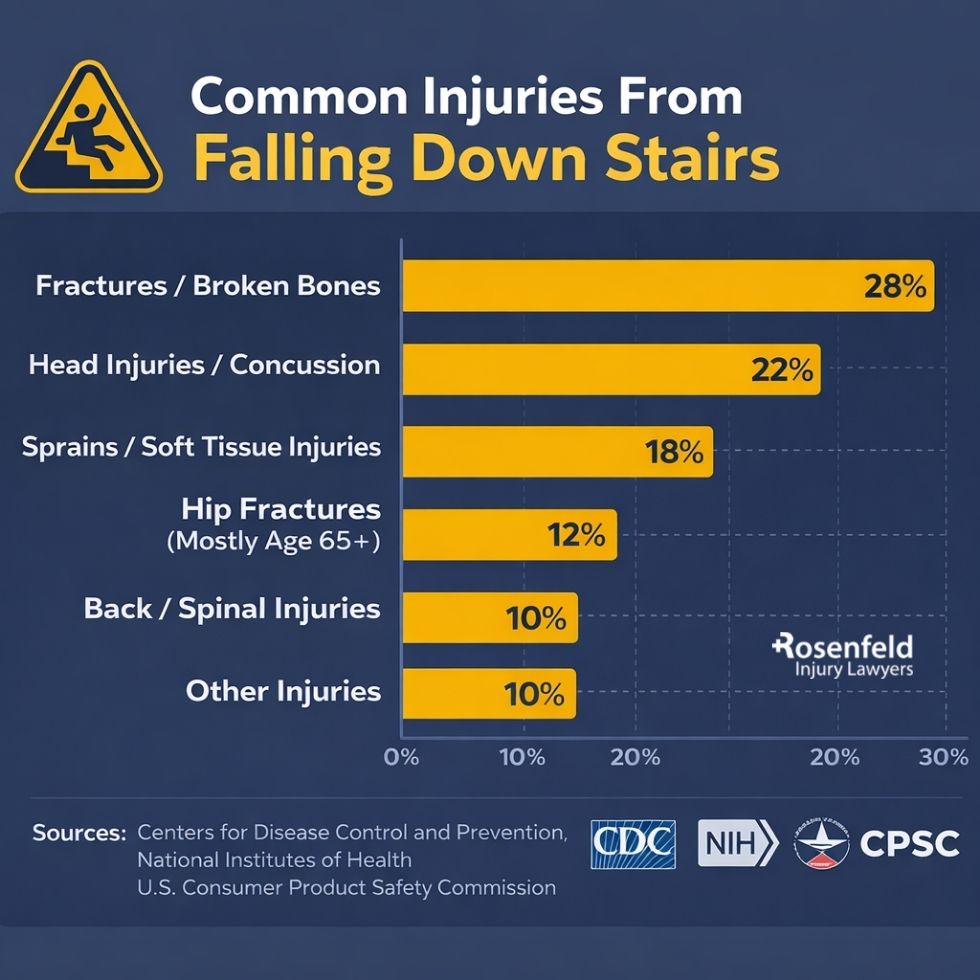
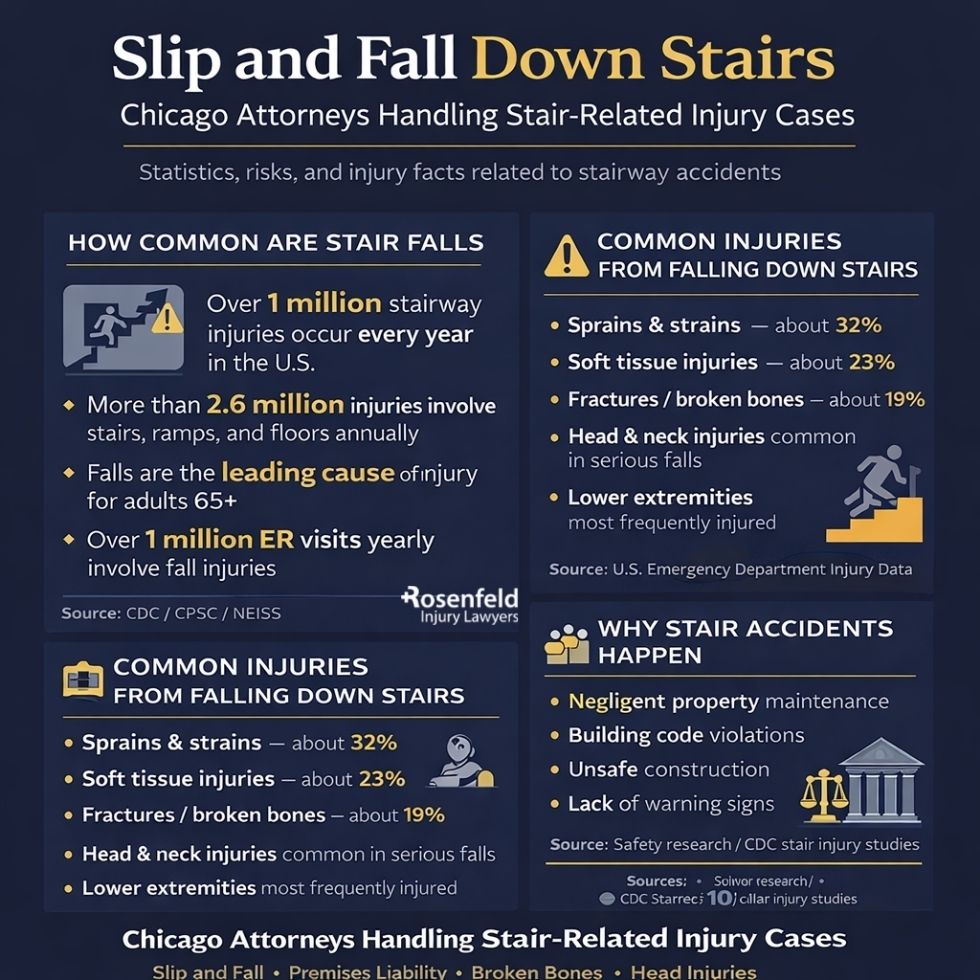
A slip and fall can lead to a wide range of serious injuries, especially when the impact involves multiple steps or sharp edges.
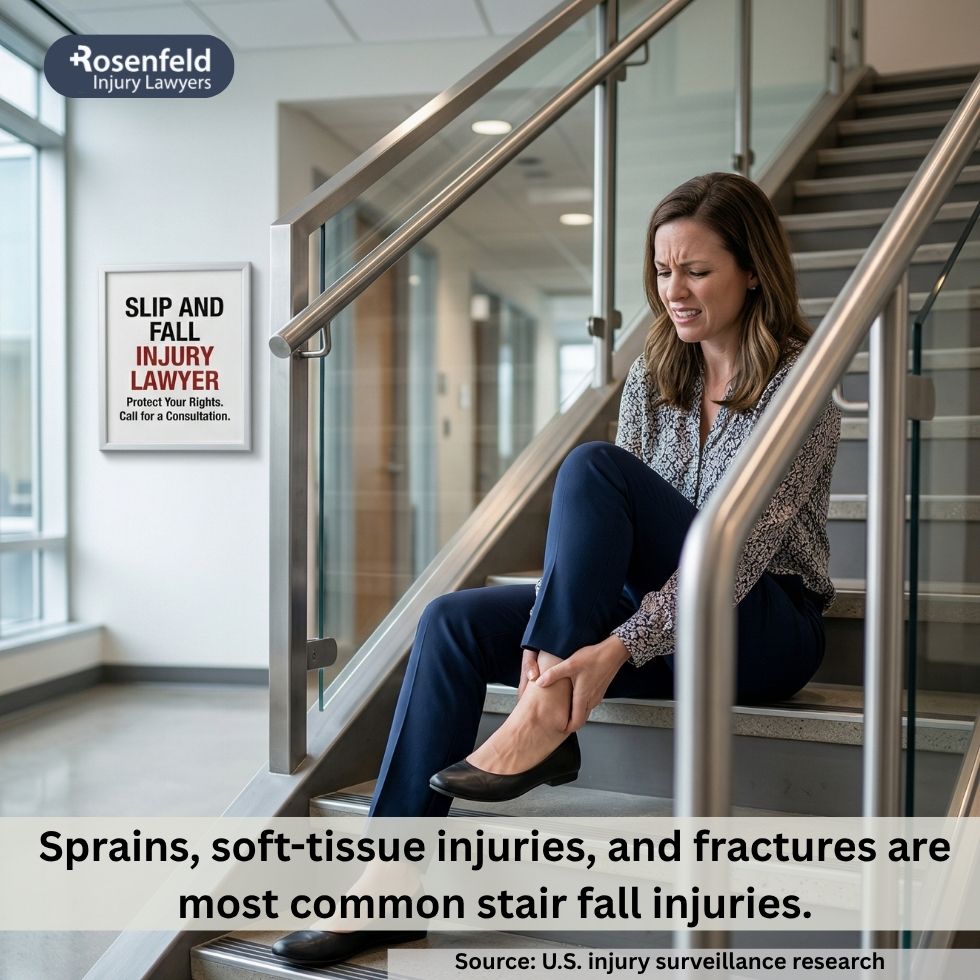
Strains, sprains, and bruising are common in stair-related accidents. These injuries affect muscles, tendons, and ligaments, leading to swelling, pain, and reduced mobility. Severe cases—like ligament tears—can require surgery and months of physical therapy.
Falling backward or landing hard on the back can cause damage to the spinal cord. These injuries may result in chronic pain, limited mobility, or even paralysis, depending on the location and severity of the trauma.
Head strikes on steps or railings can cause traumatic brain injuries. Concussions, skull fractures, and internal bleeding may lead to symptoms like memory issues, dizziness, and long-term cognitive difficulties.
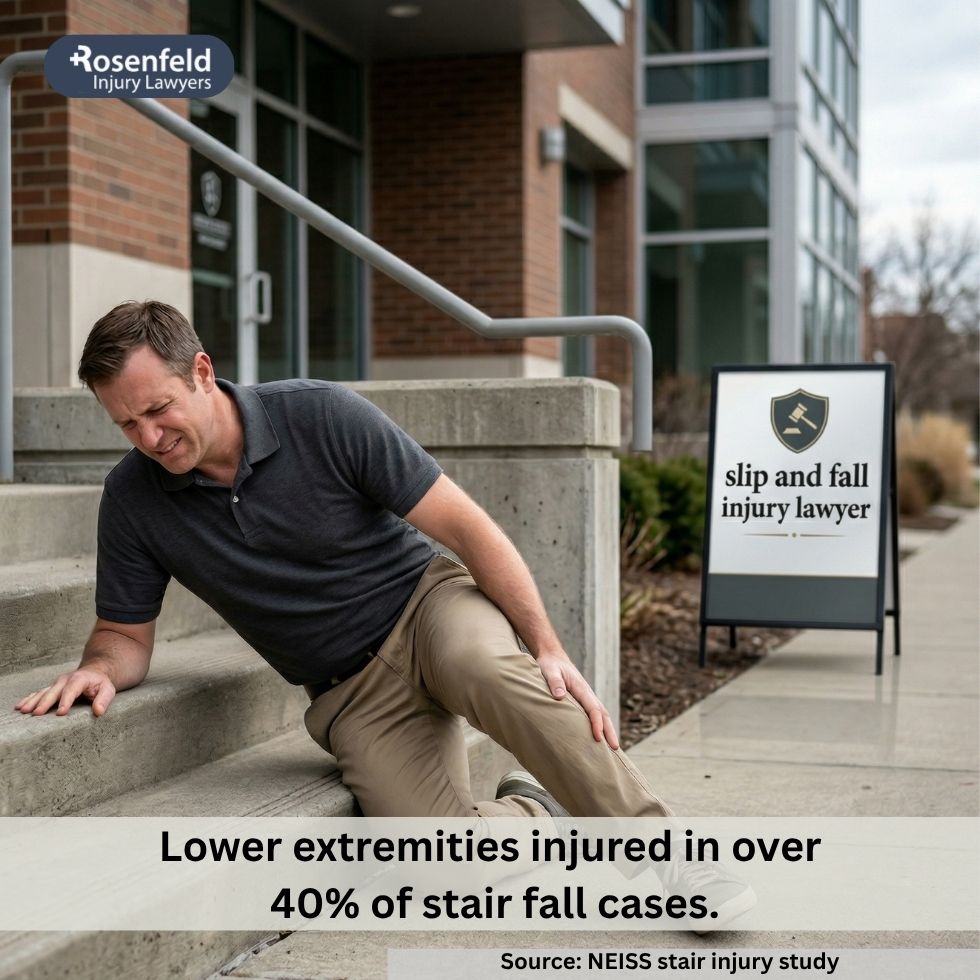
Fractures often occur when people instinctively try to catch themselves during a fall. Common breaks include wrists, hips, arms, and ankles. Some may require surgery and extensive rehabilitation, especially in older adults.
Property owners in Chicago are required by law to maintain stairwells in a safe condition. When these obligations are ignored, the risk of serious stair-related injuries increases significantly.
Poor lighting makes it difficult to see each stair clearly, especially in enclosed or windowless stairwells. Under Section 14X-6-602.3 of the Chicago Municipal Code, all stairways in residential and commercial buildings must be adequately illuminated at all times.
Stairs that don’t comply with Chicago’s building code—such as incorrect riser height, lack of uniformity, or insufficient handrails—pose serious risks. Section 14B-10-1011 outlines design requirements for stairways, including dimensions and handrail placements.
Cracked treads, loose boards, or stairs of differing heights disrupt a person’s step pattern and increase the likelihood of falling. Chicago codes require that all stair steps be uniform in height and depth.
Handrails are essential for balance and fall prevention, particularly for older adults. Section 14B-10-1011 of the Chicago Code mandates that handrails be present on at least one side of any stairway with more than three risers.
Wet or polished stair materials, especially in public buildings, can become dangerously slick. Under Section 14X-5-505.9.5, building owners must maintain floors, including stair surfaces, in a condition that is safe and non-slippery. Failure to address this risk with mats, non-slip treads, or timely cleaning can lead to serious injuries.
Frayed, bunched-up, or detached carpet poses a significant trip hazard. Chicago’s property maintenance code requires that stair coverings be kept in good repair. Damaged carpeting should be replaced or fixed promptly to avoid creating a trap for unsuspecting visitors or tenants.
Poor planning—such as staircases that are too steep, too narrow, or missing landings—can increase the danger of stairway falls. Defective design may violate Section 14B-10-1011 and related construction standards, making both contractors and commercial property owners liable for injuries caused by noncompliant stair structures.
If you suffered injuries in an accident due to someone else’s negligence, you may be entitled to recover a range of damages through a personal injury lawsuit. These commonly include:
You can recover the full cost of your medical care, including emergency room visits, hospitalization, surgery, physical therapy, medication, and any future treatment related to the fall injuries. In severe cases, this may also include rehabilitation or long-term care.
If the stair fall forced you to miss work or reduced your ability to earn income, you can claim compensation for both past and future lost income.
These address the personal toll of the accident, such as physical pain, emotional distress, reduced quality of life, and loss of enjoyment of daily activities. In severe cases, this can also include permanent disability or disfigurement.
Based on Law.com‘s VerdictSearch, the average payout for a slip and fall down stairs in Chicago is $498,861, with a median of $127,370. Case values range widely—from as low as $5,750 to as high as $4 million—reflecting the many variables that influence compensation in these cases.
Several key factors impact the value of a stair fall claim:
Each fall case is unique, and injured individuals should consult a qualified attorney to determine the potential value of their specific claim.
Rebecca Hess, 43, fell 20 feet from an interior stairway at a Chicago apartment building that lacked a handrail. She suffered a spinal fracture, resulting in paraplegia, and lived in full-time care for over four years before passing away. Her estate alleged code violations and city warnings were ignored by the property owner. The jury awarded $3 million, reduced to $2.5 million after finding Hess 25% at fault.
Christine Colantuono, a 52-year-old nurse consultant, fell on the steep upper-deck stairs at Wrigley Field due to the absence of handrails. She sustained a torn shoulder, fractured clavicle, and permanent pain. The jury awarded over $1 million, finding the stadium 80% at fault. The case later settled for $800,000.
Maria Garcia, 53, slipped on icy, dark exterior stairs at a Chicago condo building. She fractured her knee, underwent three surgeries, and will require a future knee replacement. The jury found the condo association 62.8% at fault for failing to maintain adequate lighting and awarded $1.17 million, reduced to $740,184 after comparative fault.
Stairway slip and fall accidents often involve complex premises liability issues that go far beyond simply proving you fell. Property owners and insurance companies may deny responsibility, argue that you were partially at fault, or claim the dangerous condition was “open and obvious.” Proving negligence frequently requires investigating building code violations, preserving evidence, and, in some cases, obtaining expert testimony.
In Chicago, these claims are typically handled through the Circuit Court of Cook County, where strict deadlines and procedural requirements apply. An experienced stairway slip and fall lawyer in Chicago can manage every aspect of your case—from gathering evidence and establishing liability to negotiating with insurance companies—helping maximize the compensation you deserve for your injuries, medical expenses, lost wages, and pain and suffering.
Most Chicago stairway slip and fall lawyers work on a contingency fee basis, meaning you pay nothing upfront and owe no attorney’s fees unless compensation is recovered on your behalf. This arrangement allows injured victims to pursue justice without worrying about out-of-pocket legal expenses.
During a free consultation, an attorney can evaluate your claim, explain your legal options, and discuss the potential value of your case. Whether your injuries resulted from defective stairs, inadequate lighting, or code violations, having experienced legal representation can make a significant difference in the outcome of your claim.
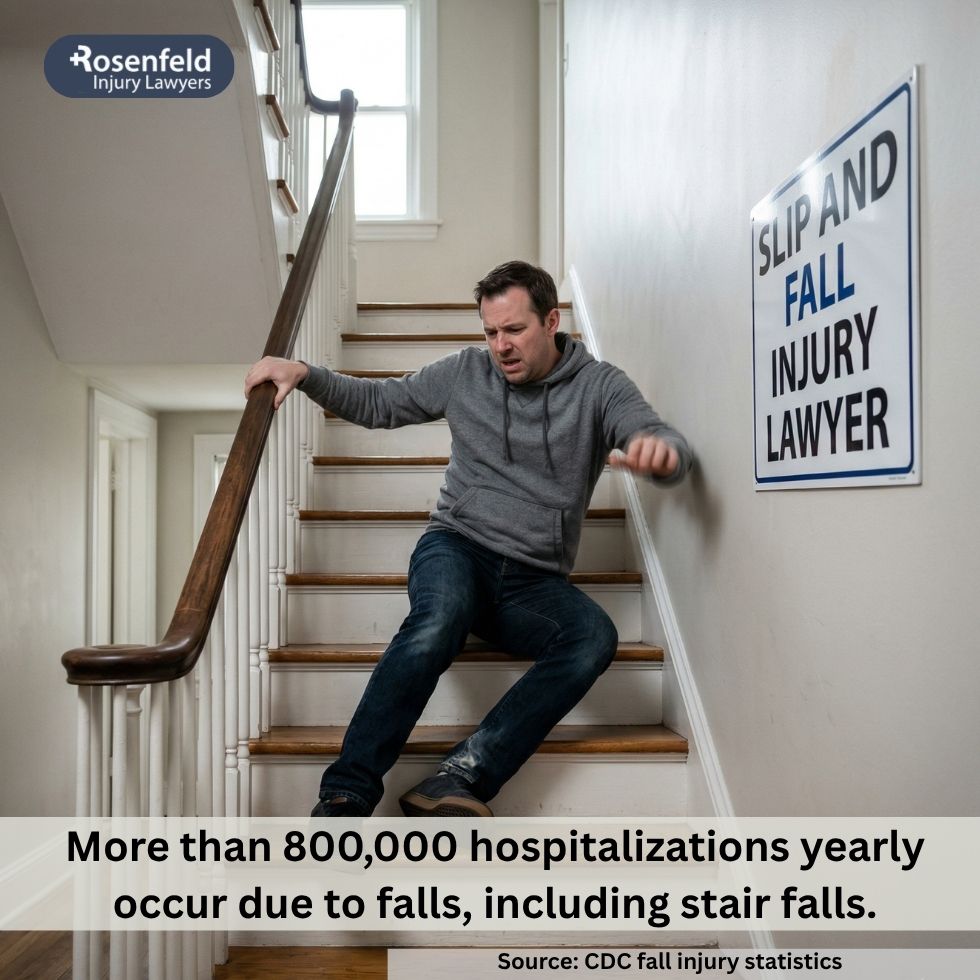
Stair slip and fall accidents are far more common than many people realize—and often far more dangerous. According to a comprehensive study published in the American Journal of Emergency Medicine, an average of over 1 million stair-related injuries are treated in U.S. emergency departments every year. That’s roughly one injury every 30 seconds.
Stairway falls in Chicago can happen just about anywhere, but specific locations tend to see more incidents due to high foot traffic, aging infrastructure, or poor maintenance.
Many fall accidents occur in older apartment buildings on the city’s North and West Sides, where damaged stairs, loose railings, or worn carpeting are often overlooked. Stair accidents are also common at CTA stations like Roosevelt, Jackson, and Belmont, where fast-moving crowds and slick stair treads increase the risk.
Hospitals such as Stroger and Mount Sinai have also seen claims involving patients or visitors falling on poorly maintained stairs. Commercial properties in the Loop and retail centers on Michigan Avenue or 87th Street may also pose hazards due to uneven steps or a lack of proper handrails.
Whether it’s a residential building, office complex, or public transit station, property owners have a legal duty to keep stairways safe. When they fail, serious injuries can result.
Slip and fall accidents on stairs in Chicago are typically governed by Illinois premises liability law, which holds property owners responsible for maintaining reasonably safe conditions for those legally on their premises (740 ILCS 130/).
If the stairway fall occurred on government-owned property—like a CTA station or public building—claims may also fall under the Local Governmental and Governmental Employees Tort Immunity Act (745 ILCS 10/). This law can limit liability and requires specific notice and filing procedures, making it more difficult to pursue compensation.
A notable case is Clifford v. Wharton Business Group, L.L.C., 353 Ill. App. 3d 34 (1st Dist.. 2004), where the court upheld a premises liability claim involving defective stairs and inadequate maintenance.
In Illinois, you generally have two years from the date of the fall to file a personal injury lawsuit under 735 ILCS 5/13-202. Failing to file within this period may forfeit your right to seek compensation for injuries caused by a stairway slip and fall accident.
Liability for stairway accidents in Chicago often falls on those responsible for maintaining the premises in a Chicago slip and fall accident case. Property owners—including landlords and commercial property owners—can be held liable in a premises liability claim if they fail to keep stairs safe and free from hazards like broken steps, poor lighting, or loose railings, which are common causes of a stairway accident injury lawsuit in Chicago. Property managers or maintenance companies may also share responsibility in a personal injury claim if they neglected needed repairs or proper stair maintenance.
In buildings owned by the city or other public entities, liability in a Chicago government premises liability case may be governed by the Local Governmental and Governmental Employees Tort Immunity Act (745 ILCS 10/). In construction zones, contractors could be held accountable in a construction site stair accident claim for defective stair design or unsafe conditions leading to a serious injury compensation case.
Defendants in stair-related injury cases often claim the hazard was “open and obvious,” suggesting the injured person should have seen and avoided it. We argue that poor lighting or distractions made it unreasonable to expect awareness. They may also raise comparative negligence, blaming the victim’s behavior.
Our team gathered evidence to show that the property owner’s failure to maintain safe stairs was the primary cause. Another common defense is lack of notice—that they didn’t know about the dangerous condition. We counter this by showing that the issue existed long enough that they should have known and taken corrective action under local safety codes.
Taking the proper steps after a stair fall in Chicago can make a significant difference in the success of your personal injury claim or Chicago slip and fall case.
First, seek immediate medical attention—even if your injuries seem minor, as this helps document your injury claim evidence. Report the incident to the property owner or manager and ask for a copy of the incident report, which is important for a premises liability case in Chicago. If possible, take photos of the stairway, including lighting conditions, missing handrails, or any damage to the steps, as visual proof is crucial in slip and fall accident claims. Keep the shoes and clothing you wore at the time, as they may help prove the fall wasn’t your fault in a Chicago stair accident lawsuit.
Get contact information for any witnesses and preserve all related medical records and medical bills, which support your personal injury compensation claim in Cook County. Avoid speaking to insurance adjusters or attorneys for the property owner without legal representation, especially an experienced Chicago slip and fall lawyer, to protect your rights in a stairway negligence case.
Our experienced Chicago stairway slip and fall lawyers provide comprehensive legal representation from the moment you file your claim until your case is resolved. We thoroughly investigate the accident scene, preserve crucial evidence, and work with safety experts to uncover building code violations, defective stairs, inadequate lighting, loose handrails, and other hazardous conditions that may have caused your fall.
Our legal team handles all communications with insurance companies and negligent property owners, focusing on proving liability and documenting the full extent of your injuries. Whether pursuing a favorable settlement or preparing your case for trial, we build compelling stairway slip and fall accident claims that account for medical bills, lost wages, pain and suffering, and future care costs. If you or a loved one has been injured in a stairway accident, contact our Chicago stairway slip and fall attorneys today for a free consultation and let us fight for the maximum compensation you deserve.
Older adults are especially vulnerable due to balance issues, poor vision, or limited mobility. Stair-related injuries are also more likely when people are carrying items, wearing improper footwear, or rushing. Many fall accidents happen in places like apartment buildings, office stairwells, and public transit stations, where maintenance may be neglected.
If your stairway fall led to broken bones, head injuries, or required medical attention, your case is likely severe. Hospital visits, physical therapy, lost earnings, and lasting pain are all indicators that your slip and fall may warrant a personal injury claim.
Yes. Always seek medical attention after a fall, even if symptoms seem mild. Many severe conditions, such as soft tissue injuries or traumatic brain injuries, may not appear immediately. A medical evaluation creates documentation of your injuries, which strengthens your personal injury case and helps prove that the fall caused your condition.
To prove liability in a stairway fall under Illinois premises liability law, you must show that the property owner owed you a duty of care, breached that duty, caused your fall, and that you sustained injuries as a result. Liability often hinges on proving one of the following:
– The owner (or an employee) created the hazard, such as a spill or torn carpeting.
– The owner knew of the dangerous condition but failed to fix it.
– The hazard existed long enough that a reasonable property owner would have discovered and repaired it.
Photos, incident reports, code violations, and witness statements are all valuable in showing that the owner failed to maintain safe stairs.
Illinois follows a modified comparative negligence rule under 735 ILCS 5/2-1116. You can still recover compensation if you were less than 50% responsible for the fall. However, your damages will be reduced by your percentage of fault.
If your stairway fall occurred while on the job, you may be entitled to benefits under the Illinois Workers’ Compensation Act (820 ILCS 305/). These benefits may include medical care, temporary disability payments, and coverage for permanent impairments.
If you or a loved one were injured in a slip and fall down stairs in Chicago, don’t wait to get legal help. At Slip & Fall Injury Lawyers, we offer a free consultation to review your case and explain your options. Our law firm works on a contingency fee basis, so you pay nothing unless we recover compensation for you. We understand the profound impact stair-related injuries can have on your health, finances, and future.
Contact us to speak with an experienced stairway fall attorney who’s ready to help.
 Legally Reviewed By
Attorney Jonathan Rosenfeld
The information on this page has been legally reviewed by Attorney Jonathan Rosenfeld, founder and managing partner of Rosenfeld Injury Lawyers LLC, a Chicago-based personal injury law firm. With decades of experience representing individuals injured in slip and fall accidents and other premises liability cases throughout Chicago, Mr. Rosenfeld is dedicated to protecting the rights of injury victims and helping them pursue the maximum compensation available under the law. His extensive legal knowledge and commitment to client advocacy ensure that the information provided is accurate, reliable, and aligned with current legal standards.