
Experienced Attorneys. Proven Results.
Hire the Team That Knows How To Win and Maximize the Value of Your Case



Wet floor slip and fall accidents occur when moisture, spills, leaks, or recently cleaned surfaces create hazardous walking conditions. These incidents can happen in grocery stores, restaurants, office buildings, apartment complexes, and other properties throughout Chicago. Depending on the circumstances, property owners and occupiers may be held liable when they knew or should have known about a dangerous condition and failed to take reasonable steps to prevent injuries.
Wet floor slip and fall accidents are one of the most common reasons people end up in Chicago emergency rooms. At Slip & Fall Injury Lawyers, we represent individuals who’ve been seriously hurt because a property owner failed to keep their floors safe.
Whether your injury happened at a grocery store, office building, or apartment complex, our legal team knows how to investigate these cases and hold the responsible party accountable.

At Slip & Fall Injury Lawyers, we focus on helping fall victims recover compensation after injuries caused by slippery floors in Chicago. Our attorneys have secured millions on behalf of injured clients throughout Illinois and are recognized by the Million Dollar Advocates Forum and Super Lawyers for results in premises liability cases.
In one case, Matt, a 47-year-old shopper, slipped on a wet floor near the produce section of a Chicago grocery store. The store had failed to place any wet floor signs, despite recent cleaning and multiple employee walkthroughs. He suffered a fractured pelvis and required surgery, followed by months of physical therapy.
Our legal team showed the store had notice of the slippery floor hazard and didn’t take reasonable measures to prevent the fall. His $2 million settlement reflected the serious injuries and his ongoing limitations.
Yes, you can sue if you slipped due to a missing “Wet Floor” sign, especially if the property owner knew or should have known about the slippery condition. Failing to post proper signs can be considered negligence, giving injured parties grounds for a premises liability claim in Illinois.
In Chicago, property owners are expected to use signs when wet or slippery floors pose a hazard. This includes freshly mopped surfaces, spills in grocery store aisles, tracked-in rain or snow at building entrances, and leaks near coolers or restrooms. Failing to display a “Wet Floor” sign in these situations may violate the property owner’s legal duty to provide a safe environment.
Businesses like shopping malls, stores, and offices must take reasonable care to prevent slips and falls. When a warning sign is missing, and someone gets hurt, that failure can support a slip and fall lawsuit under Illinois premises liability law.
Slip and fall accidents on wet or slippery floors often lead to painful and sometimes lasting injuries.
Common outcomes include broken bones, especially wrists, hips, and ankles, as well as back injuries and herniated discs. Head trauma, including concussions and traumatic brain injuries, can occur if the injured party strikes the ground hard. Many victims also suffer from sprains, torn ligaments, and deep bruising.
These injuries may require emergency room visits, surgery, physical therapy, and long-term care. Even a single fall can cause serious injuries that lead to mounting medical bills and lost wages.
To prove negligence in a wet floor slip and fall accident, you need to prove four legal elements: duty, breach, causation, and damages. A veteran wet floor slip and fall lawyer Chicago residents trust can take these factors and build a solid premises liability case.
First, the property owner must have owed you a duty to keep the premises reasonably safe. Grocery stores, retail stores, shopping malls, restaurants, office buildings and other commercial properties where visitors are expected generally owe such duty. Under Illinois premises liability law, property owners must fix known problems and control unsafe conditions.
Next, you must show the owner breached that duty, for example, by failing to clean up a spill, repair a leak, or place a “wet floor” warning sign near a slippery surface. A failure to conduct regular inspections or properly maintain the premises may constitute negligence in a Chicago slip and fall case.
Causation means the breach directly caused your fall. This could involve proving that the absence of warning signs, inadequate maintenance, or the failure to inspect the property created the hazardous condition that led to your wet floor slip and fall injury.
Finally, you must prove damages, such as medical expenses, lost wages, pain and suffering, rehabilitation costs, or ongoing treatment for fall injuries. Photos of the accident scene, witness statements, surveillance footage, medical records, and maintenance logs can help support your premises liability lawsuit and strengthen your claim for compensation with the assistance of a wet floor slip and fall lawyer in Chicago.

In addition to property owners, several other parties may be liable for slips and falls caused by slippery floors.
Business operators—such as store managers, restaurant chains, or cleaning companies—can be held responsible if they created or ignored a slippery floor hazard. For example, a janitorial crew that mops without placing wet floor signs or a store employee who fails to clean up a spill may share fault.
In leased properties, the tenant business—not the landlord—may be liable if they control the area where the fall occurred. Identifying all responsible parties can strengthen your slip and fall case and improve your chances of recovering compensation.
To strengthen your wet floor slip and fall case, take action immediately after the incident. Prompt action can help preserve evidence and improve your chances of recovering compensation with the assistance of a wet floor slip and fall lawyer Chicago residents trust.
Get medical help immediately, even if your injuries seem minor. Medical treatment records are vital evidence connecting your slip-and-fall accident to your injuries. Notify the store or the property manager of the wet floor slip and fall accident and ask for a copy of the incident report. If possible, take photographs of the wet floor hazard, absence of warning signs, and any obvious injuries. Get the names of witnesses who saw the fall or the dangerous conditions that caused it.
Keep records of all medical bills, lost wages, and any communications with the responsible party or his/her insurance company. Do not record a statement for the insurance company until you have spoken to an attorney. Working with an experienced Chicago slip and fall lawyer can help preserve evidence, identify liable parties, and build a strong premises liability claim. The more documentation you have, the better you will be positioned to seek compensation for your injuries, pain and suffering, and other damages from a wet floor slip and fall accident.
Wet floor injury cases in Chicago are primarily governed by the Illinois Premises Liability Act (740 ILCS 130/). This law holds property owners and occupiers responsible for maintaining reasonably safe conditions for people legally on their premises. When a slippery floor causes an injury, liability hinges on notice, foreseeability, and failure to act.
Under Illinois’ modified comparative negligence rule (735 ILCS 5/2-1116), an injured victim can still recover damages if they were less than 50% at fault for the fall. However, their compensation is reduced in proportion to their percentage of fault. This can heavily influence wet floor slip and fall settlements.
In Illinois, you have two years from the date of the fall accident to file a personal injury lawsuit (735 ILCS 5/13-202). Missing this deadline can result in losing your right to seek compensation, regardless of how strong your case may be.
In Zuppard, the court ruled in favor of Wal-Mart because the plaintiff failed to prove the store had actual or constructive notice of the spill. This case underscores the importance of proving that a property owner knew—or should have known—about the dangerous condition.
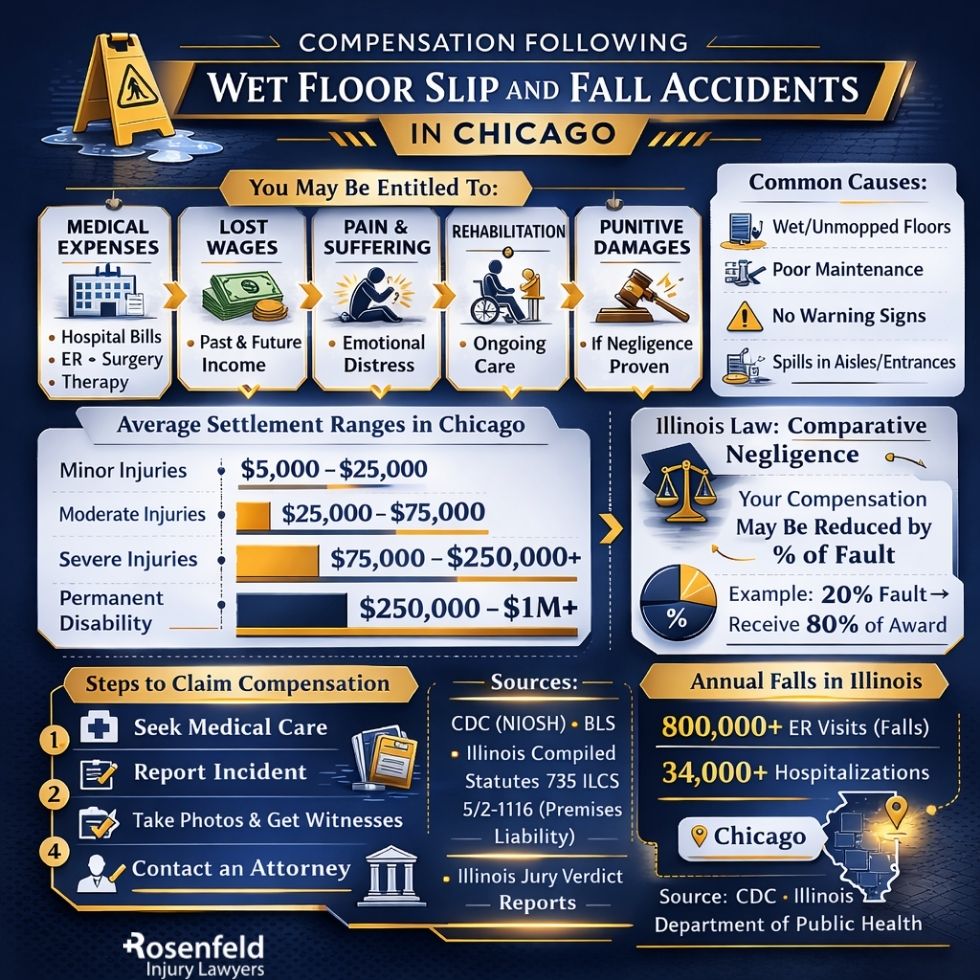
Victims of slippery floor falls in Chicago may be entitled to recover compensation for both economic and non-economic damages. Economic damages include medical expenses, physical therapy costs, and lost earnings due to missed work. Non-economic damages may cover pain and suffering, emotional distress, loss of a normal life, and permanent disability.
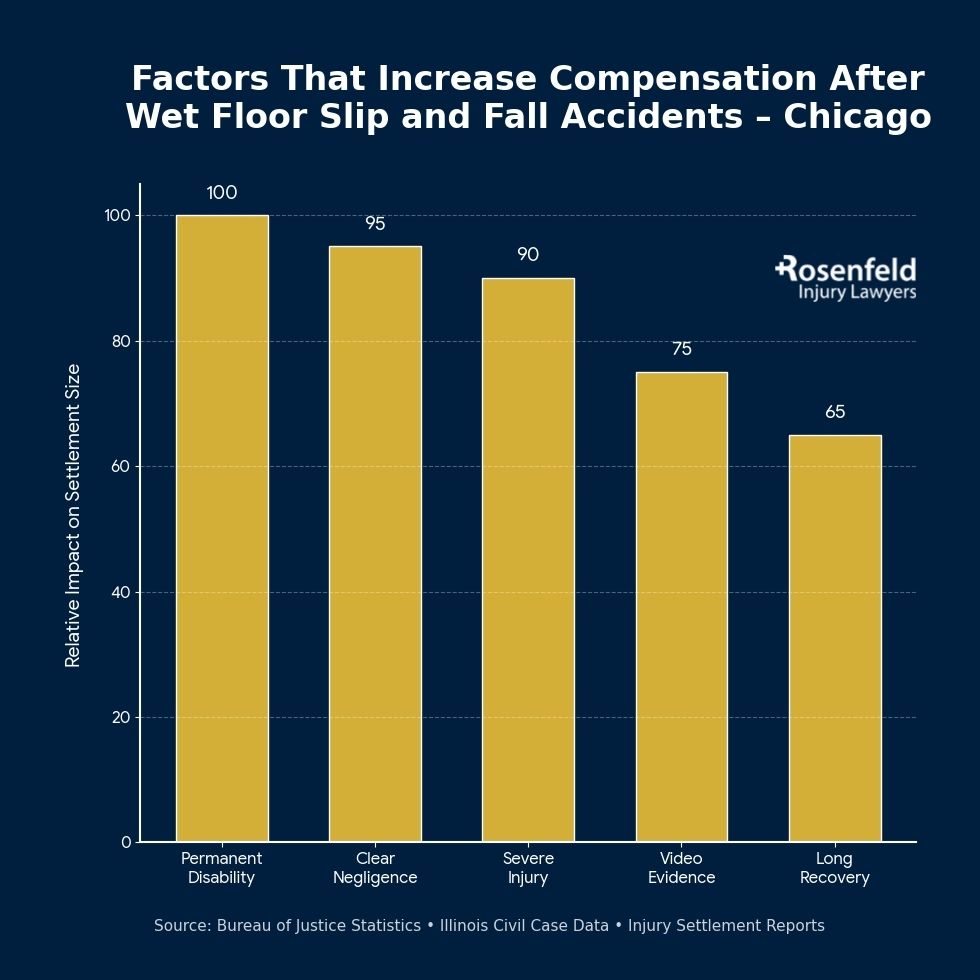
If the fall results in serious injuries like broken bones or traumatic brain injuries, the value of a slip and fall case may increase. A successful claim requires substantial evidence of the incident, such as maintenance records, witness testimony, and medical documentation.
According to Law.com, the average wet floor slip and fall payout in Chicago is $403,364, with a median settlement of $335,000. These figures come from case results where fall victims pursued compensation for injuries caused by slippery floors, often in locations like grocery stores, office buildings, or malls.
Settlement values vary based on several factors, including:
Every slip and fall accident is unique, so consulting with an experienced lawyer is key to understanding how much compensation you may be entitled to.
Jeffrey Acker, a 47-year-old ironworker, slipped on wet bentonite while working in a DePaul University basement construction project. He suffered a torn rotator cuff, underwent two surgeries, and could not return to full-duty work. Acker sued multiple contractors, arguing they failed to maintain safe working conditions.
The parties disputed responsibility, with each blaming the other for not covering or drying the slippery surface. Acker ultimately settled for $1.16 million before trial, with contributions from several defendants. His workers’ comp lien of over $250,000 was waived as part of the settlement.
Judd Daniels, 45, who has a congenital condition and uses crutches, slipped on a wet ceramic tile floor while exiting the Steamplant Family Restaurant. He sustained major fractures to his arm, requiring surgery. Daniels claimed no signs were posted, and multiple witnesses confirmed the floor was wet.
The defense denied that mopping had occurred and cited Daniels’ preexisting condition. The jury awarded $1 million to Daniels for his injuries and $75,000 to his wife for loss of consortium.
Gene Richardson, 71, slipped on a recently mopped floor in a Waukegan office kitchen while working as a security guard. The only wet floor sign was behind a closed door, offering no warning. He suffered bilateral quadriceps tears and a shoulder injury, requiring surgery and extensive physical therapy.
Richardson sued the cleaning company and kitchen operator, both of whom disputed negligence and claimed contributory fault. The parties settled for $1.04 million, which included the resolution of a workers’ comp lien of $144,000.
Wet floor slip and fall accidents in Chicago are common in high-traffic public and commercial spaces where spills, leaks, or recent cleaning often leave slippery floors.
Grocery stores, like Jewel-Osco and Mariano’s, frequently see fall accidents near produce aisles or freezer sections. Office buildings, restaurants, and malls such as Water Tower Place and Ford City Mall also report frequent slip and fall incidents, especially near entrances on rainy or snowy days.
Inadequate maintenance, missing wet floor signs, and poor lighting all contribute to these hazards. Property owners and operators have a duty to address these risks and prevent falls.
Wet floor accidents can happen almost anywhere, but they are particularly common in:
High-traffic areas, entrances, restrooms, produce sections, and food courts are especially prone to slippery conditions. Businesses have a duty to inspect these areas regularly and take reasonable steps to protect visitors from preventable injuries.
If you’re injured at work, your primary option is to file a workers’ compensation claim. However, if a third party—like a cleaning contractor or property manager—was responsible for the slippery floor, you may also be able to file a separate personal injury lawsuit.
If you’re insured, your health insurance may initially cover your medical bills. Workers’ compensation can also help if the fall happened on the job. In personal injury cases, providers may treat you under a lien, meaning payment is deferred until your case settles or you win in court.
Slip & Fall Injury Lawyers works on a contingency fee basis. That means you pay nothing upfront. We only collect a fee if we secure compensation for you, either through a settlement or a verdict. Your consultation is free, and we’ll explain all your legal options clearly.
Falls on slippery floors can often be avoided with regular inspections, proper use of wet floor signs, and immediate cleanup of spills. Businesses should train staff to recognize and respond to hazards. Property owners are expected to take reasonable steps to keep walking surfaces safe and dry.
In most cases, Illinois law gives injured victims two years from the date of the accident to file a premises liability lawsuit. Missing this deadline could prevent you from recovering compensation, so it is important to speak with a wet floor slip and fall lawyer in Chicago as soon as possible.
Victims of wet floor slip and fall accidents may be entitled to compensation for medical expenses, lost wages, rehabilitation costs, pain and suffering, and diminished earning capacity. The amount you can recover depends on the severity of your injuries and the circumstances surrounding the accident.
The absence of a warning sign may help establish property owner negligence in a slip and fall case. Businesses and property owners have a duty to address hazardous conditions and warn visitors of known dangers. Failure to do so can strengthen a premises liability claim.
If you were injured in a slippery floor accident in Chicago, you don’t have to deal with the consequences alone. At Slip & Fall Injury Lawyers, our experienced attorneys are ready to help you understand your legal rights. Contact us to schedule your free case evaluation with a trusted slip and fall attorney near you.
 Legally Reviewed By
Attorney Jonathan Rosenfeld
The information on this page has been legally reviewed by Attorney Jonathan Rosenfeld, founder and managing partner of Rosenfeld Injury Lawyers LLC, a Chicago-based personal injury law firm. With decades of experience representing individuals injured in slip and fall accidents and other premises liability cases throughout Chicago, Mr. Rosenfeld is dedicated to protecting the rights of injury victims and helping them pursue the maximum compensation available under the law. His extensive legal knowledge and commitment to client advocacy ensure that the information provided is accurate, reliable, and aligned with current legal standards.