
Experienced Attorneys. Proven Results.
Hire the Team That Knows How To Win and Maximize the Value of Your Case



If you’ve been in a slip and fall accident, such as falling down the stairs at a State Street store, you may be overwhelmed by the personal injury claim process. With over 100 years of combined experience, our attorneys are highly familiar with how to negotiate a slip and fall settlement and will push the insurance company for maximum compensation. Contact us today for a free consultation about your legal options.

In Illinois, premises liability law is primarily determined by the Premises Liability Act (740 ILCS 130/2). The elements of a premises liability case include four factors: duty, breach, causation, and damages. Each of these comes together to prove a property owner’s negligence.
Duty of care means that the property owner had a responsibility to protect invitees from potential danger, including slip and fall accidents. They must fulfill a standard of care, which is what a reasonable person would expect in the given circumstances.
For example, the Chicago Municipal Code requires that stairs be in good repair and structurally sound (13-196-570). If you visited a Wrigleyville condominium to watch a Cubs game, the owner must ensure that stair treads are secure and the railings are properly maintained. If they fail to do so, our premises liability lawyers can hold them liable for these hazards.
Breach of duty in a slip-and-fall case means that the property owner failed to uphold their duty of care to guests. For example, the Illinois Supreme Court case Ward v. K Mart Corp found that a K Mart store in Champaign County could be held liable for a customer slamming into a concrete post while carrying a bulky item.
It is assumed that a company will take reasonable care to prevent such collisions, especially if it is aware that customers may have obstructed vision.
Causation means that the significant injuries sustained in the slip-and-fall accident were primarily caused by the property owner’s failure to provide a safe environment. For example, assume that you fell on an icy sidewalk in the Loop. The Chicago Municipal Code requires that property owners clear sidewalks and other walking paths in a timely manner (4-4-310 & 10-8-180).
As such, the property owner’s failure to clear the sidewalk was the primary cause of your injuries, not your own actions.
Damages in slip and fall cases are meant to compensate you for both financial losses and intangible harm, like loss of enjoyment of life. You will need to document these costs, like medical expenses and lost wages. Our personal injury attorneys will also calculate non-economic damages, like pain and suffering or loss of enjoyment of life, on your behalf.
Your personal injury attorney will collect evidence to support your slip and fall accident case. This evidence will demonstrate the property owner’s liability, document your damages, and consider how the severe injuries have impacted your quality of life.
Evidence that we can gather includes:
Statements from your loved ones, professionals, and eyewitnesses can be crucial to winning a case, but they must be collected correctly. Depositions are the process of taking sworn statements outside of the courtroom, which provide additional context.

While depositions are not always admissible at trial, a witness who lies during a deposition can be impeached for lying under oath. Gathering this information requires crafting straightforward questions that do not lead the witness but provide important information. Deposition questioning is a skill, and how questions are framed affects what the testimony is worth later.
We can also utilize subpoenas to obtain information that may be more challenging for the average person to access, such as a store’s maintenance records or surveillance footage. Together, these provide a complete narrative of the events and can demonstrate clear liability.
We must demand a certain settlement amount based on the evidence. To do this, we use a slip and fall injury settlement calculator that weighs your economic damages against your pain and suffering.
A demand letter is the document that formally requests this amount from the insurance company. A strong one typically includes:
Economic damages are your hard financial losses that can be proven through invoices, receipts, bills, and pay stubs. These include:
It is important to keep meticulous records throughout your recovery. Gather any receipts for out-of-pocket expenses, such as medical transportation, and collect all bills from your healthcare providers. We will use this to estimate your total damages and request an appropriate sum from the applicable insurance agency.
Non-economic expenses cover the social and emotional impact on the injured party, such as the inability to enjoy their hobbies or continue working. These can include:
To demonstrate these damages, we can gather testimony from doctors, medical professionals, and your loved ones. You can also provide photos and videos from before and after the accident to show the impact on your everyday life.
Lastly, personal accounts of the accident, such as pain diaries and photos of your injuries, can demonstrate the significant impact that the fall has had on your life. For example, you can explain how you suffer from nightmares of the accident, are afraid to walk up stairs, or can no longer enjoy your everyday activities.
Working with an experienced personal injury attorney gives you a better chance of securing fair compensation in a slip and fall incident. Not only are we highly familiar with state and local premises liability law, but we can accurately evaluate your damages and negotiate with the relevant insurance provider.
Our team works on a contingency fee basis, so there is no risk to scheduling an initial consultation. Contact our personal injury attorneys today to discuss your slip-and-fall case.
Settlement discussions typically occur before filing a personal injury lawsuit in the Circuit Court of Cook County.
We begin settlement negotiations by evaluating all your damages and determining an appropriate demand, which we then submit with your claim. This is done by examining all elements of the slip and fall accident, including whether you suffered severe injuries and how they impacted your life.

A demand letter, as outlined above, sets out the settlement figure we’re requesting and the evidence behind it. We send this to the insurance company, and they respond with a counteroffer based on their own investigation.
Insurers evaluate these claims to limit what they pay, and several common tactics are worth recognizing.
Lowballing: Insurance companies are aware that the average person is unfamiliar with the claims process and may not know what a reasonable offer looks like in their specific case. As such, they will often provide a low settlement offer, hoping that you will not ask for more. Because we understand the value of a case like yours, we’ll counter with a more realistic figure.
Delaying and Refusing to Investigate: The company may ask for excessive documentation that is irrelevant to the claim, or they may continually hand off your case to different adjusters, so you have to explain the same things every time. They might also refuse to explain policy exclusions or hide information about the specific policy.
Denying Valid Claims: Denying a valid claim is considered a bad-faith insurance tactic and, if caught, can lead to legal trouble for the company (215 ILCS 5/154.6). Still, companies may justify the denial using procedural defenses or by insisting that you did not provide enough evidence.
Blaming the Claimant: Because Illinois uses comparative negligence laws, the insurer can deny a claim if you are considered primarily responsible for the accident. They may insist that your clothing, footwear, or previous medical history is to blame, and the property owner did not play a significant role in the fall.
Surveillance and Medical Disputes: If you suffered serious injuries and your claim is significant, the company may put you under surveillance, attempting to prove you’re not as hurt as you claim. They will also review your medical expenses and argue that these were not medically necessary to your recovery.
To win a slip and fall claim, we must prove negligence. Illinois uses modified comparative negligence, meaning that everyone involved in the case is assigned a portion of the blame. If you are not more than 50% responsible, you can file for damages, but your settlement amount will be reduced by your percentage of blame (735 ILCS 5/2-1116).
Our role is to demonstrate that the property owner was aware of the issue, or should have been aware of it, and failed to address it. This is separated into two potential arguments: actual notice and constructive notice.
Actual notice means that someone has directly informed the property owner of a hazardous condition on their premises. For example, if a previous slip and fall incident had been reported to management, this would be considered actual notice.
Constructive notice means that a reasonable property owner would have been aware of a problem. For example, a Logan Square arcade owner should establish a regular cleaning schedule to identify issues such as spilled drinks, broken tiles, cracked pavement, or dim lights that can conceal uneven surfaces. If the owner does not regularly inspect the premises, they may be liable for this negligence.

There are several other arguments that property owners may use to diminish their liability. The open and obvious hazard defense means that the property owner is not responsible for fixing the issue because it was apparent to anyone. This defense was employed in the Illinois Supreme Court case Cope v. Doe, which held that owners cannot be held liable for obvious hazards, such as a retention pond.
Another legal defense is called assumption of risk. This means that the injured person agreed to the potential danger by visiting the premises. You may see this argument in cases involving sports, but it can also occur in cases involving a simple slip and fall, such as tripping down a flight of stairs in a restaurant on the Gold Coast. We must demonstrate that the injuries you suffered do not adhere to accepted standards of risk.
Finally, the owner may argue that this was not a foreseeable hazard, which could be a valid point in some unusual circumstances. As an example, if you suffer a slip and fall accident due to a sudden gust of wind, this would not be the owner’s fault. On the other hand, falling off a balcony because the guardrail had rusted is a foreseeable hazard that the owner should have fixed.
Once the insurer responds with a counteroffer, we’ll assess whether we believe the settlement amount will adequately cover all your needs, including future medical treatment and lost wages. If it does not, then we can return with another counteroffer, or we can move on to the litigation stage.
Most slip and fall cases are settled out of court because litigation is time-consuming and requires extensive resources. However, some insurers will refuse to provide a fair settlement amount. We’ll review the offer and decide whether it’s worth filing a lawsuit with the Circuit Court of Cook County.
Factors we consider include whether there is clear and compelling evidence of liability, the discrepancy between our calculated damages and the proposed settlement amount, and the projected timeline for the lawsuit process.
If we decide to go forward with a personal injury lawsuit, we will file a complaint with the court. A judge will review the complaint and determine whether there is a valid case; if so, hearings will be scheduled to investigate further.
We will then gather evidence, such as depositions with witnesses, and share it with the other parties, a process known as discovery. We may need to file motions to extend the timeline or request additional information from other parties involved.
If the lawsuit proceeds, the court will select a jury, and we will present our evidence.
It’s important to remember that if a jury decides against you, then you may not receive anything. We would also need to appeal by moving to a higher court, which takes additional time and resources. Our attorneys will explain this to you throughout the process, allowing you to decide whether to accept the settlement offered by the insurer.
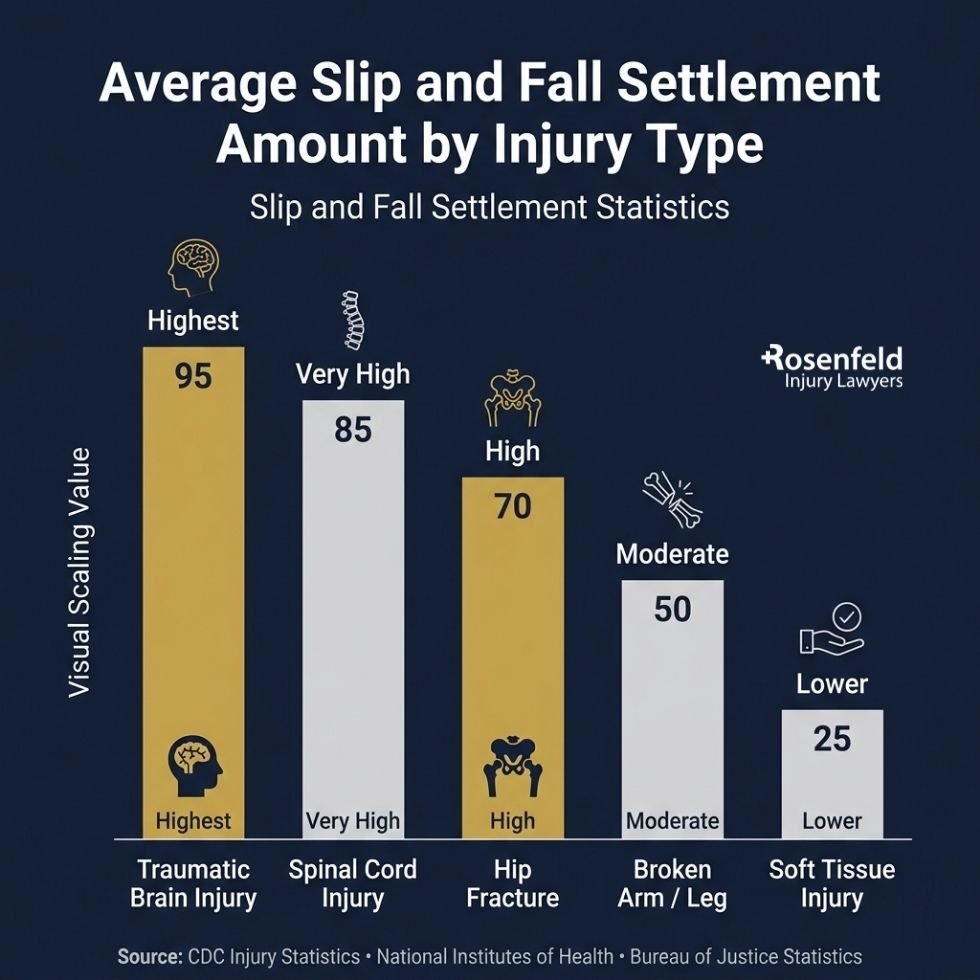
Illinois has a two-year statute of limitations for personal injury cases (735 ILCS 5/13-202). If you miss this deadline, you will not be able to recover compensation for your slip and fall. Contact us today to get started.
According to data from Law.com‘s VerdictSearch, the average slip and fall settlement in Chicago is $417,200. Some cases have settled for as little as $5,750, while the highest reported payout can reach $3,288,805. The median settlement sits at $181,250, indicating that half of all recoveries fell below that figure.
At our Chicago law firm, the average recovery in slip and fall cases is $1,730,746.
We have secured millions on behalf of our clients, ensuring that they have the funds they need to recover in comfort. These are only some of the many successful slip and fall cases we have settled.
$4,000,000: Frank, a patient recovering from hip replacement surgery, fell in the hospital and suffered a fatal subdural hematoma. This wrongful death settlement demonstrated that the hospital failed to adequately supervise Frank, leading to his accident.
$2,600,000: Tyler, a construction worker, fell while working on a construction site. He required expensive and painful knee surgery. We proved that the property owner was liable for failing to provide a safe environment.
$2,000,000: A young woman named Kimberly fell and fractured her pelvis after a slip and fall case outside of a church. We demonstrated that the church did not salt the walkways, which violates the city’s municipal codes around snow and ice removal (4-4-310 & 10-8-180).
$1,500,000: Casper, an elderly man, fell down a flight of stairs in an apartment building. Through meticulous research, we were able to demonstrate that the property owner had not complied with municipal building codes, including those related to secure railings.
A settlement could take anywhere from a few months to a few years, depending on the specific factors involved. Cases that are settled outside of the Circuit Court of Cook County will be resolved faster, as you do not have to worry about court schedules.
In contrast, one that is sent to the Illinois First District Appellate Court in Chicago will take longer because an appeal is an additional trial. The longest cases are sent to the Illinois Supreme Court, where complicated arguments about local laws must be thoroughly investigated before a decision can be made.
Read more about the factors that affect how long a settlement takes.
Numerous factors influence the timeline, including the following.
Severity of Injuries: Insurers and attorneys want to ensure that you have reached maximum medical improvement (MMI) before beginning negotiations. This makes it easier to determine your medical expenses and provides a more accurate estimate of your total damages.
Complexity of Case: A slip and fall case with multiple liable parties, unclear liability, or a lack of evidence will take much longer to complete.
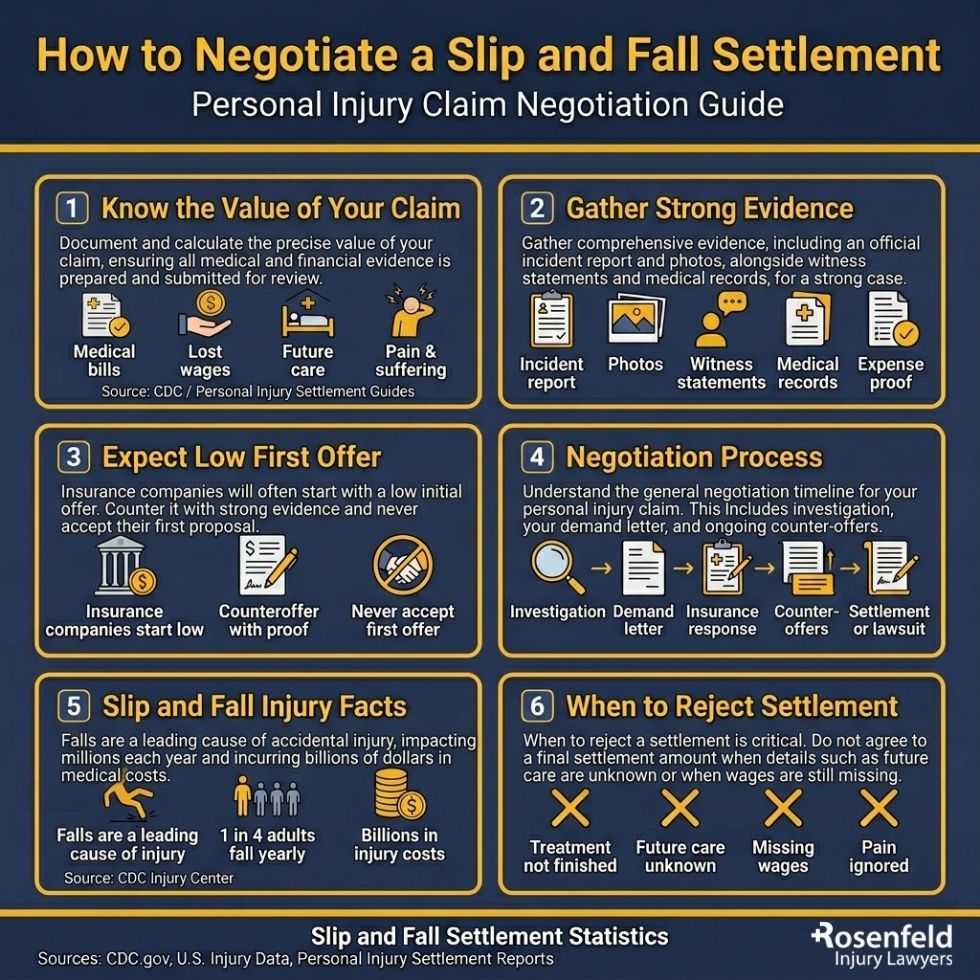
Insurance: If the insurance agency is willing to negotiate, your case will likely proceed much faster. On the other hand, claims involving multiple insurance policies, lapsed policies, or no insurance coverage will take longer.
Negotiation Strategies: Insurers often attempt to run out the statute of limitations, preventing you from making a claim. This is especially true if they know you have a strong case and quality legal assistance. They will do this by requesting spurious documentation, changing adjusters, claiming that you filled out the paperwork incorrectly, or simply not responding to your requests.
Legal Representation: Having an attorney by your side can significantly speed up the process. We have a full complement of attorneys and legal assistants available to investigate your case, file paperwork, attend hearings, and communicate with third parties.
Most personal injury cases settle out of court. A slip and fall lawsuit is expensive and time-consuming for the insurance company, so they would rather provide adequate compensation without going to trial. However, in some slip and fall cases, the insurance company may refuse to negotiate or offer a lowball settlement. In these cases, we will file a lawsuit and pursue your personal injury claim in court.
This is not recommended. In most cases, the insurance company will suggest a very low settlement figure, assuming that you cannot evaluate your damages. This is especially true if you do not have an attorney or have major injuries that will require long-term care.
Never talk to the insurance agency without an experienced attorney at your side. We can thoroughly evaluate all offers based on the evidence and compare them to successful cases with similar circumstances, such as a slip and fall case on an icy sidewalk downtown.
We can also shield you from deceptive insurance tactics, such as claiming that the property owner wasn’t liable for your injuries because of what you were wearing.
Those who choose to represent themselves in negotiations will likely face a more challenging time securing full compensation. You should hire a personal injury attorney experienced in slip and fall cases to increase your chances of success.
Insurance providers use a variety of tactics to prevent you from receiving a reasonable settlement for a slip and fall incident, including delaying their investigation, claiming you were at fault for the injuries sustained in the fall, or using your medical records to claim your injuries were due to a pre-existing condition.
An experienced attorney will thoroughly investigate your case and utilize all applicable laws to prove negligence, giving you a better chance of pursuing fair compensation.
Whether a slip and fall settlement is taxable often depends on how the award is allocated between physical injury and other damages. It is always advisable to know in-depth about is my settlement taxable
Our personal injury attorneys have handled thousands of cases and work on a contingency fee basis, meaning that you owe us nothing unless we win your personal injury claim.
Contact an experienced slip and fall attorney today by calling us for a free initial consultation. Reach our Chicago attorneys directly, or fill out the form below to get started. [Change: added internal link near the closing CTA per the sheet’s section 7, pointing to the attorney bios page.

Legally Reviewed By
Attorney Jonathan Rosenfeld
The information on this page has been legally reviewed by Attorney Jonathan Rosenfeld, founder and managing partner of Rosenfeld Injury Lawyers LLC, a Chicago-based personal injury law firm. With decades of experience representing individuals injured in slip and fall accidents and other premises liability cases throughout Chicago, Mr. Rosenfeld is dedicated to protecting the rights of injury victims and helping them pursue the maximum compensation available under the law. His extensive legal knowledge and commitment to client advocacy ensure that the information provided is accurate, reliable, and aligned with current legal standards.