
Experienced Attorneys. Proven Results.
Hire the Team That Knows How To Win and Maximize the Value of Your Case



If you were hurt at a Chicago Home Depot, the store’s warehouse layout may be the reason your injury happened at all. A Home Depot slip and fall lawyer in Chicago looks at more than wet floors here, because overhead racking, forklifts, and bare concrete create risks that a typical retail store never has to answer for. Falling merchandise, powered equipment moving through customer aisles, and outdoor lumber yards all raise questions a standard retail store slip and fall claim does not.
Injured at a Chicago Home Depot? Falls, falling merchandise, and equipment injuries in a warehouse store can involve more than one liable party. Free case review: 312-800-1534.
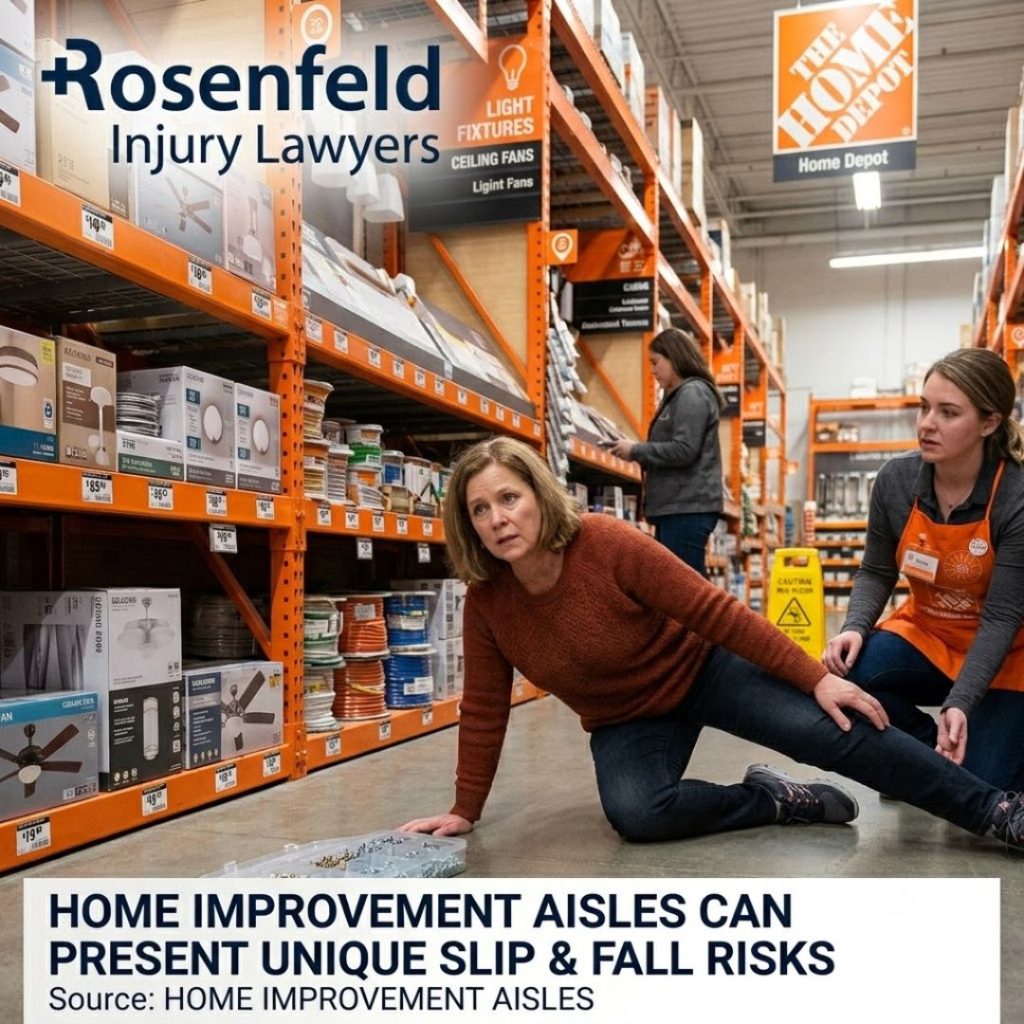
Home Depot operates less like a shop and more like a warehouse the public is invited to walk through. Merchandise sits on industrial racking well above shoppers’ heads, powered equipment shares floor space with customers during business hours, and much of the flooring is exposed concrete rather than tile or carpet. A Home Depot slip and fall lawyer in Chicago treats these as industrial hazards, not ordinary shop hazards, because the evidence and the liability theory both look different from what applies to a general merchandise store like the one covered on our Walmart slip and fall claims page.
Some of the most serious Home Depot injuries do not come from slipping at all. Merchandise stored on overhead racking that can become hazardous if it is improperly stacked, exceeds applicable weight limits, or is not adequately secured. A falling merchandise injury claim depends on different evidence than a spill claim, including:
These claims often overlap with the overhead hazard risk associated with construction site falls, where stacked or elevated materials are involved.
Forklifts and other powered industrial trucks may operate in areas accessible to customers during business hours, creating additional safety considerations. That combination raises both premises liability and operational negligence questions. Occupational Safety and Health Administration standards for powered equipment can serve as evidence of the standard of care expected of the store and its staff, even though OSHA itself does not confer a private right of action on customers. If you were struck or injured near moving equipment, records of operator training and aisle-clearing procedures often become central to the claim, in much the same way ladder accidents turn on equipment maintenance and training records.
Home Depot’s lumber yard and garden center are located partly or entirely outdoors, which brings Chicago weather into the picture. Snow, ice, rain, and uneven gravel or pallet surfaces create fall risks that indoor aisles do not. Illinois law distinguishes between natural and unnatural accumulations of snow and ice, a distinction explained further on our snow and ice slip-and-fall claims page. Outdoor loading areas also see forklift and cart traffic, which compounds the risk during Chicago winters.
Bare concrete floors carry their own problems. Sawdust from the lumber department, spilled paint or adhesive, and general product debris can sit on concrete for extended periods before anyone notices. Because concrete does not show wear the way carpet does, constructive notice, meaning the store should have discovered the hazard through reasonable inspection, is frequently the deciding factor. Documenting how long a spill or debris pile was present, and whether staff walked past it, is central to building this part of the case.
Working out who is responsible, the store, a vendor crew, or a contractor, takes records you cannot request yourself. Call 312-800-1534 for a free review.
Some products at Home Depot are stocked and merchandised by third-party vendor crews rather than store employees. That matters because it can create a second, separately liable defendant, particularly when Home Depot argues it had no notice of the hazard a vendor created. A thorough investigation determines whether the store, a contractor, or a vendor is responsible, and sometimes more than one of them shares fault under the Illinois Premises Liability Act, 740 ILCS 130. Illinois also applies comparative fault under 735 ILCS 5/2-1116. A claimant generally may recover damages when they are not more than 50% responsible, although the recovery is reduced according to their share of fault.
Every Home Depot injury claim depends on the specific facts, including the type of injury, the medical treatment involved, and which party or parties are found liable. Rather than estimate a figure, we encourage you to review our settlement calculator and amounts resource, which reflects real case data rather than a guess. Our team gathers stocking records, forklift logs, vendor contracts, and maintenance history before discussing what your specific claim may be worth.
If merchandise fell on you, or you were hurt by equipment or a floor hazard at Home Depot, we will investigate who was responsible and what records exist. Free consultation, no fee unless we win. Call 312-800-1534.
Cases involving warehouse-style stores are typically filed in the Circuit Court of Cook County, and Illinois law gives you two years from the date of injury to file under 735 ILCS 5/13-202. Waiting reduces the likelihood that racking logs, forklift maintenance records, and vendor contracts will still be available.
You may have a claim if the merchandise was improperly stacked, secured, or maintained on the racking. Liability can rest with Home Depot, the vendor who stocked the item, or both, depending on stocking records and racking maintenance history.
Injuries involving powered equipment in customer areas can raise both premises liability and negligence questions. Operator training records, aisle procedures, and applicable safety standards often help establish whether the store met its duty of care.
When a third-party vendor crew stocks or merchandises a product, that vendor may share liability alongside the store. Contracts and stocking logs help determine which party controlled the condition that caused your fall.
An incident report can support your claim, but it is written from the store’s perspective and may not include every detail. It is one piece of evidence among photos, witness statements, and maintenance records.
Illinois generally allows two years from the date of injury to file a personal injury claim. Speaking with a lawyer promptly helps preserve stocking, maintenance, and equipment records before they are lost or overwritten.