
Experienced Attorneys. Proven Results.
Hire the Team That Knows How To Win and Maximize the Value of Your Case



A university campus slip and fall lawyer in Chicago can tell you which rules apply when falls happen on a university or college campus.
Chicago has one of the densest concentrations of colleges and universities in the Midwest, and every one of them carries some kind of slip and fall risk: icy quads, worn stairwells, crowded dorm hallways, and construction zones that never seem to finish.
If you fell on a Chicago college campus, the school you attend changes your case more than almost anything else.
A fall at DePaul University or Loyola University Chicago is a straightforward premises liability claim. A fall at University of Illinois Chicago (UIC) or Chicago State University involves a state agency, a different court, and a filing clock that moves much faster than most students realize.
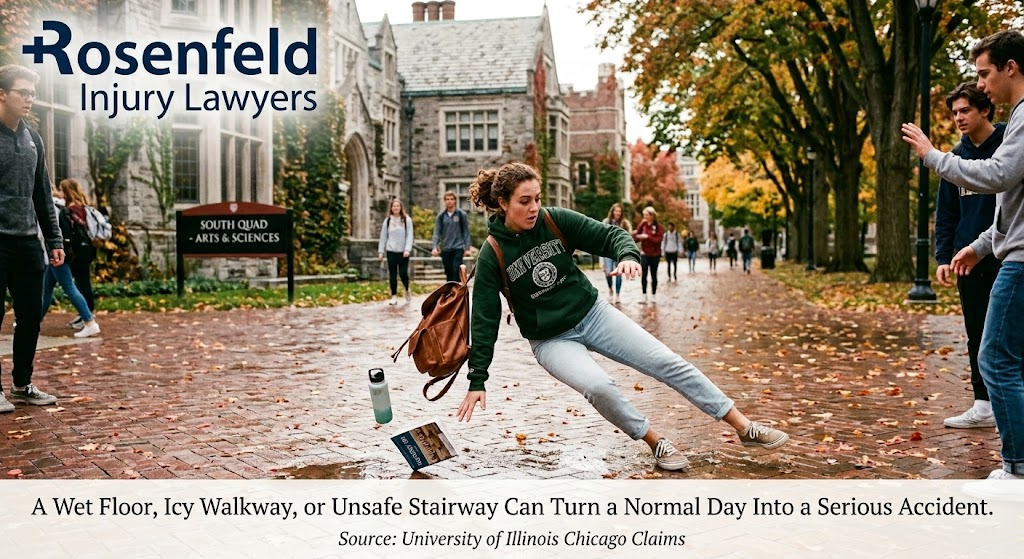
College campuses pack an unusual amount of foot traffic into a small footprint, and that raises the odds of a campus slip and falls.
Common fall locations include:
This is the distinction that matters most for your understanding;
A fall on private university grounds is handled like any other college campus injury claim under the Illinois Premises Liability Act, 740 ILCS 130, filed in the Circuit Court of Cook County under the standard rules that apply to businesses, landlords, and stores.
Public universities, including the University of Illinois Chicago (UIC), Chicago State University, and Northeastern Illinois University, are treated as State of Illinois entities.
A claim arising from university negligence at one of these schools generally must proceed through the Illinois Court of Claims under 705 ILCS 505, not the Circuit Court of Cook County. The doctrine behind this is sovereign immunity: the state can only be sued in the ways it has agreed to be sued, and the Court of Claims is that agreed-upon forum.
A third category sits in between. City Colleges of Chicago campuses are local public entities, not state agencies, so claims against them fall under the Local Governmental and Governmental Employees Tort Immunity Act, 745 ILCS 10, the same statute that governs government property claims against the city itself.
Under Illinois premises liability law, most personal injury claims must be filed within two years of the fall under 735 ILCS 5/13-202. Students who fell at a private university generally fall under this standard window.
Claims against public universities and other state entities do not follow that timeline. Court of Claims cases carry their own notice and filing procedures that are considerably shorter than the ordinary two-year period.
City Colleges of Chicago claims carry their own one-year deadline under the Tort Immunity Act
Let the college campus slip and fall lawyer Chicago confirm your deadline the same week the fall occurs.
A dorm injury claim follows the same underlying premises liability principles as any other fall on campus, but it comes with a condition;
Students are legally considered invitees on university property, including dormitories, which means the school owes a student invitee status duty of reasonable care regardless of housing contract language. Common dormitory hazards include:
Dormitory premises liability claims can involve the university directly, a third-party housing management company, or both, depending on who actually controls maintenance and repairs in the building.
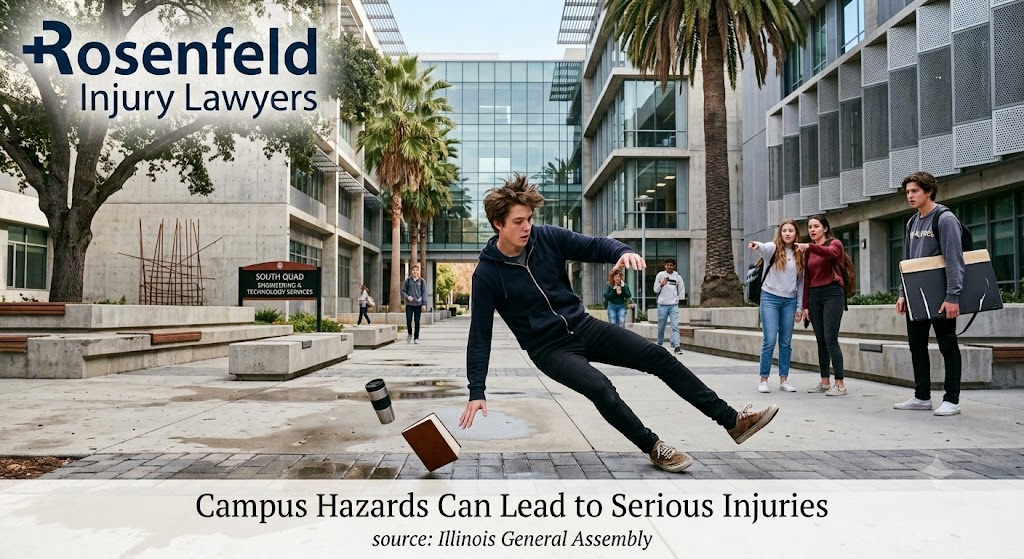
Snow and ice on walkways connecting dorms, dining halls, and lecture buildings are among the most frequent causes of falls reported on Chicago campuses each winter.
Snow and ice slip and fall claims on campus often turn on whether the university or its contractor had a reasonable window to clear the hazard before your fall. The same is true of stairway falls in older academic buildings, where worn nosing, inadequate handrails, or poor lighting can turn a routine trip between classes into a serious injury.
Large campuses rarely handle their own snow removal, janitorial work, or grounds maintenance in-house. Instead, they contract it out, which introduces a third-party maintenance contractor into the liability picture.
This matters for two practical reasons. First, if the university itself is entitled to sovereign immunity or a shortened Court of Claims process, the maintenance company may still be fully liable under ordinary Illinois premises liability rules. Second, campus premises liability cases involving contractors often require pulling maintenance logs, service contracts, and work orders to determine who was actually responsible for the hazard on the day you fell.
Identifying every potentially liable party is one of the most overlooked steps in a campus injury case, and it is often where additional recovery is found.
The value of a campus injury claim depends on the severity of your injuries, the strength of the evidence showing the university or contractor knew about the hazard, and which legal track your claim falls under.
Notice requirements play an outsized role in campus cases. Whether you are pursuing a private university under ordinary premises liability rules or a public university through the Court of Claims process, proving the school knew or should have known about the hazard, through prior complaints, work orders, or inspection records, is central to the claim’s value.
Chicago’s universities each carry their own legal rules, and getting that distinction wrong can cost a student their entire claim. A Chicago campus injury lawyer can identify the correct process, confirm your deadline, and pursue every liable party on your behalf.
Contact us today for a free case review and let us explain which track applies to your school.
Yes. Students, visitors, and families are legal invitees owed a duty of reasonable care. Whether you sue in Circuit Court or through the Illinois Court of Claims depends on whether your school is a private or public institution.
Yes. Private schools like DePaul or Loyola are sued like any property owner under 740 ILCS 130. Public schools like UIC are state entities, and claims typically proceed through the Illinois Court of Claims under 705 ILCS 505.
Claims against state universities follow Court of Claims notice and filing procedures that are shorter than the standard two-year premises liability window.
Yes. Signing a housing agreement does not waive your right to a safe living environment. Dormitory falls are evaluated under the same premises liability duty owed to any student invitee.
No. Pursuing a personal injury claim is a private legal matter separate from your academic standing, housing status, or financial aid eligibility, and it should not affect any of them.

Legally Reviewed By
Attorney Jonathan Rosenfeld
The information on this page has been legally reviewed by Attorney Jonathan Rosenfeld, founder and managing partner of Rosenfeld Injury Lawyers LLC, a Chicago-based personal injury law firm. With decades of experience representing individuals injured in slip and fall accidents and other premises liability cases throughout Chicago, Mr. Rosenfeld is dedicated to protecting the rights of injury victims and helping them pursue the maximum compensation available under the law. His extensive legal knowledge and commitment to client advocacy ensure that the information provided is accurate, reliable, and aligned with current legal standards.