
Experienced Attorneys. Proven Results.
Hire the Team That Knows How To Win and Maximize the Value of Your Case



A warehouse slip and fall lawyer Chicago starts with one question: who were you on the day you fell? Staff, agency worker or visiting driver, the answer decides which claim you have.
Hurt in a Chicago warehouse? If anyone other than your own employer contributed to the fall, you may have a claim beyond workers’ compensation. Free case review: 312-800-1534.
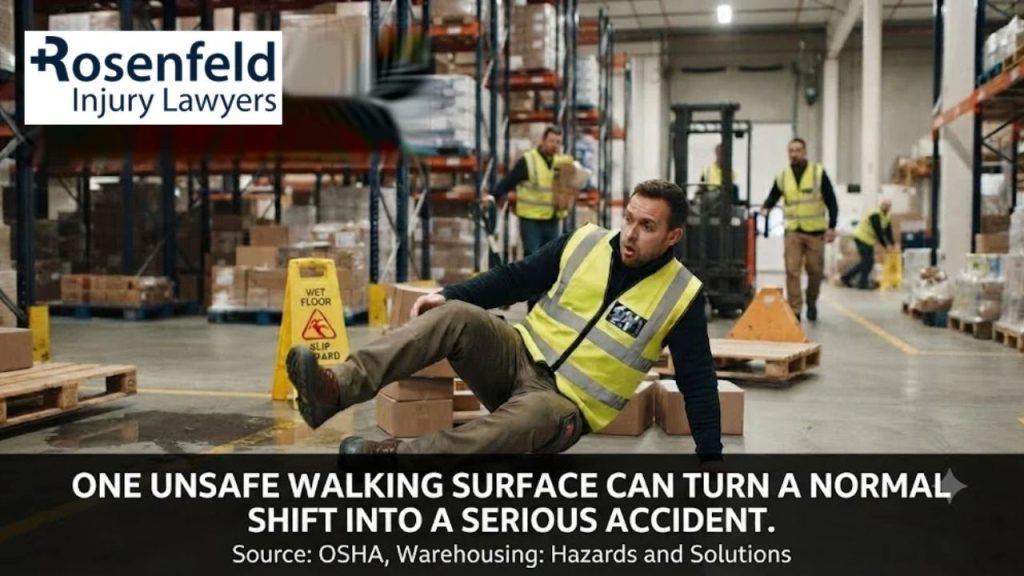
A warehouse slip and fall lawyer in Chicago sorts your status first, because it sets the route:
On the Southwest and West Side industrial corridors and in the O’Hare logistics belt, all three can work one shift in one building.
Workers’ compensation (820 ILCS 305) pays medical bills and part of lost wages without proving fault. Under the exclusive remedy rule, you generally cannot sue your own employer.
A third-party liability claim targets someone else: the property owner, another contractor, an equipment supplier or a maintenance company. It can pay for pain and suffering, which workers’ compensation does not.
Your employer or its insurer may have a lien on part of a third-party recovery (820 ILCS 305/5(b)), so we handle both claims together. See work-related falls.
Workers’ compensation does not pay for pain and suffering. A third-party claim can. Call 312-800-1534 to find out whether you have one.
A temp worker injury claim is harder to sort. When a staffing agency places you, the host business may be treated as a borrowed employer under the borrowed employee doctrine, with the same protection as the agency.
Whether that applies turns on control: who directed your work, trained you and could send you home. Staffing agency liability and host liability need separate review.
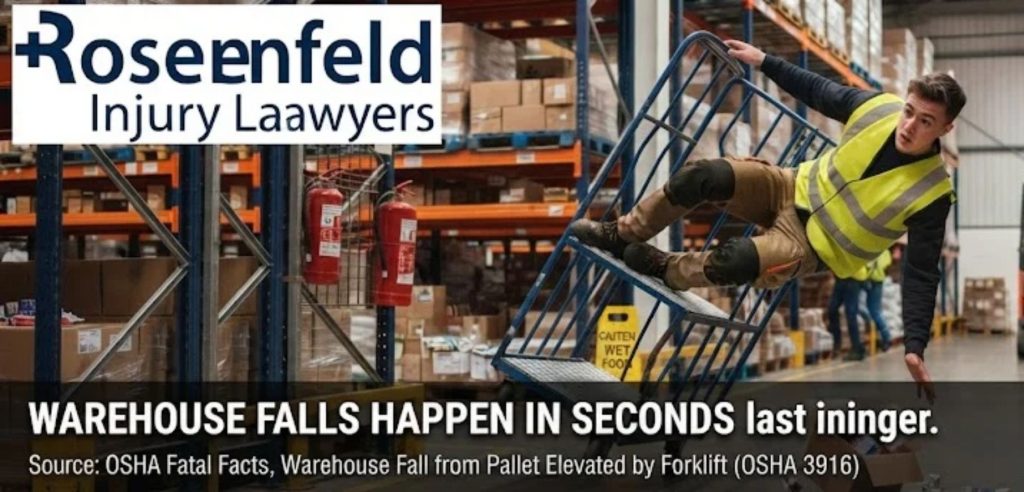
A driver, contractor or vendor rep is a lawful entrant, owed reasonable care by whoever controls the property. You may also have workers’ compensation through your own employer, but that does not stop a claim against the warehouse.
Site trades have their own risks. See construction site falls.
A loading dock fall involves hazards found nowhere else:
A warehouse floor hazard such as shrink wrap, pallet splinters or leaked product on concrete can send a worker down fast. We ask how long it sat there and who was supposed to check. See concrete surface falls.
A forklift pedestrian collision often involves a powered industrial truck in an aisle with poor sight lines. OSHA’s powered industrial truck standards are evidence of what a careful operator should have done. OSHA gives no private right to sue.
Falls from rolling ladders and picker platforms are covered in ladder accidents.
There is no fixed value. Workers’ compensation pays set benefits. A third-party claim looks at medical bills, lost wages in a slip and fall claim, and pain and suffering. We fight for fair compensation.
An injured person can still recover damages as long as they are not more than 50% at fault, but the compensation is reduced by their share of fault (735 ILCS 5/2-1116). Most personal injury claims in Illinois must be filed within two years of the accident (735 ILCS 5/13-202). Report a work injury to your employer right away. Lawsuits are usually filed in the Circuit Court of Cook County.
We will work out who was responsible for the area where you fell, whether a contractor or equipment supplier shares liability, and what claims are open to you. Free consultation, no fee unless we win. Call 312-800-1534.
Talk to a warehouse slip and fall lawyer in Chicago and request a free case review.
Usually not your own employer, because workers’ compensation is the exclusive remedy. You may still have a third-party liability claim against a property owner, contractor, equipment supplier or maintenance company whose negligence contributed to the fall. A lawyer can identify who that might be.
Workers’ compensation may be available through the agency, and the host business may also be treated as a borrowed employer. That turns on control and the facts. Other companies on site, such as contractors or equipment suppliers, may face a separate third-party claim.
Yes. A delivery driver is a lawful entrant, so you may bring an ordinary premises liability claim against the warehouse owner or operator. Your own employer’s workers’ compensation may also apply, but it does not necessarily bar a claim against the warehouse.
No. Workers’ compensation pays medical care and part of lost wages without proof of fault, but not pain and suffering. A third-party claim can include pain and suffering. The employer’s insurer may have a lien on part of that recovery (820 ILCS 305/5(b)).
You may have a third-party claim against the equipment supplier, a maintenance company or another contractor, even if you cannot sue your employer. OSHA powered industrial truck standards can serve as evidence of the standard of care, though OSHA itself gives no private right to sue.
 Legally Reviewed By
Attorney Jonathan Rosenfeld
The information on this page has been legally reviewed by Attorney Jonathan Rosenfeld, founder and managing partner of Rosenfeld Injury Lawyers LLC, a Chicago-based personal injury law firm. With decades of experience representing individuals injured in slip and fall accidents and other premises liability cases throughout Chicago, Mr. Rosenfeld is dedicated to protecting the rights of injury victims and helping them pursue the maximum compensation available under the law. His extensive legal knowledge and commitment to client advocacy ensure that the information provided is accurate, reliable, and aligned with current legal standards.