



Who’s Liable for a Fall in a College Dorm or Student Housing?


A fall in a dorm room shouldn’t end with a student paying medical bills alone. But that’s exactly what happens when nobody explains who’s actually responsible.
Think about this scenario: a first-year student falls down into a pool of water outside the common bathroom. There are no rugs or signs anywhere. The only thing that remains is a cracked floor that has been reported two times but never repaired.
The result? A broken wrist, a failed test, and lots of questions unanswered.
This is where dorm room injury liability university questions get complicated fast.
Universities, private landlords, and management companies all try to point fingers elsewhere. Knowing who actually owes a duty of care is the first step toward getting compensated.
Does a University Owe Students a Duty of Care in Dorms?
The answer to this question is a big yes. Illinois law treats a university much like any other property owner or landlord. Once a school collects rent, tuition-linked housing fees, or a signed housing agreement, it assumes a legal duty to keep those buildings reasonably safe.
This duty applies to the hallways, staircases, common bathroom areas, washing facilities, and common lounges. This duty will apply to the actual room in which the accident occurred if the institution is responsible for the maintenance and repair of such areas.
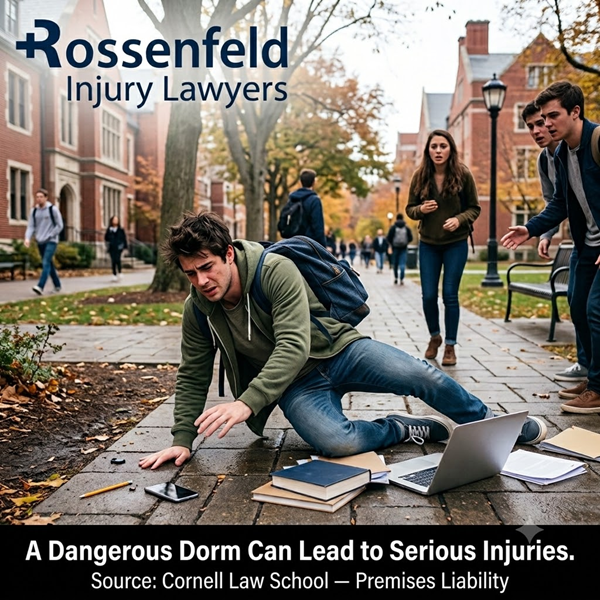
Who Can Be Held Liable for a Student Housing Fall?
Liability in student housing rarely rests with just one party. Depending on where the fall happened, several parties could share the blame:
- The university, if it owns and operates the dorm directly
- A private management company hired to run the residence hall
- A third-party landlord, for off-campus student apartments
- Maintenance or janitorial contractors responsible for repairs
- Individual students, only if their own conduct clearly caused the hazard
Off-campus student housing works much like a standard apartment building fall claim. The landlord still owes tenants a safe environment, regardless of their age or student status.
Common Causes of Dorm and Student Housing Falls
Dorm buildings age fast. Heavy foot traffic, shared facilities, and stretched maintenance budgets create real hazards.
- Wet Bathroom and Shower Floors: Communal bathrooms see constant water traffic and rarely get anti-slip mats.
- Worn or Broken Stairwells: Dorms with decades-old staircases often have loose handrails, uneven treads, or poor lighting.
- Icy walkways and Entryways: Campus sidewalks between dorms and lecture halls become dangerous fast when snow removal lags.
- Damaged Furniture or Flooring: Sagging carpet, broken tile, or unstable loft beds cause falls inside the room itself.
- Poor lighting in Stairwells and Parking Areas: Burned-out bulbs left unreplaced for weeks are a common contributing factor.
How Do You Prove Negligence in a Dorm Fall Case?
Proving a dorm room injury liability university claim works the same way as any premises liability case does. Your attorney has to show four things: duty, breach, causation, and damages.
Duty means the school or landlord owed you a safe environment. Breach means they failed to fix or warn about a known hazard. Causation ties that hazard directly to your fall. Damages cover your medical bills, pain, and lost time.
What Damages Can a Student Recover After a Dorm Fall?
Students injured in a dorm fall can pursue the same categories of compensation as any other slip and fall victim. That includes medical expenses, rehabilitation costs, and reimbursement for missed classes or work-study hours.
Non-economic damages cover pain, emotional distress, and disruption to a student’s academic year. Common injuries range from broken bones and knee injuries to back injuries and, in serious cases, head and brain injuries.
Are Dorm Injury Claims Different From Regular Apartment Claims?
Generally, no. Dorm injury claims are subject to many of the same legal standards as apartment fall claims. The main difference is who owns or operates the property: a university housing department rather than a private landlord.
That difference matters for notice requirements. If the dorm is operated by a public university, special notice rules similar to those for government property may apply. Private and religious universities, however, typically follow standard premises liability rules for landlords and tenants.
Understanding the elements of a premises liability claim can help students determine whether unsafe conditions on university property may support a potential claim.
What Should a Student Do After a Dorm Fall?
Fast action protects both your health and your claim. Follow these steps:
- Get medical attention right away, even for minor injuries.
- Report the fall to your resident assistant or housing office in writing.
- Photograph the hazard, your injuries, and the surrounding area.
- Get contact information from any roommates or witnesses.
- Avoid signing anything from the university’s insurer without legal advice.
- Contact an experienced injury lawyer as soon as possible.
Talk to a Slip and Fall Attorney About Your Dorm Injury Claim
A fall in student housing can derail your semester fast. Medical bills, missed classes, and a slow-moving housing office shouldn’t be problems you have to handle alone.
At Slip & Fall Injury Lawyers, our experienced attorneys investigate dorm and student housing falls across Illinois. We work to identify every potentially liable party, preserve critical evidence, and pursue the full compensation you may be entitled to. Contact us today for a free consultation. You pay nothing unless we win.
Frequent Asks Question:
Yes, if the school knew about a hazard and failed to fix it. Universities are treated like any other property owner under Illinois premises liability law.
It affects who you sue, not whether you have a claim. On-campus injuries usually involve the university directly. Off-campus student housing usually involves a private landlord, similar to any apartment claim.
You may have a claim against that individual, but property owners can still be liable if they knew about the hazard and failed to address it.
Generally, you have two years from the date of the fall under Illinois law. Claims involving public university property may carry shorter notice deadlines.
Yes. If the injury happened in Illinois, Illinois law generally applies, regardless of your home state or country.

Legally Reviewed By
Attorney Jonathan Rosenfeld
The information on this page has been legally reviewed by Attorney Jonathan Rosenfeld, founder and managing partner of Rosenfeld Injury Lawyers LLC, a Chicago-based personal injury law firm. With decades of experience representing individuals injured in slip and fall accidents and other premises liability cases throughout Chicago, Mr. Rosenfeld is dedicated to protecting the rights of injury victims and helping them pursue the maximum compensation available under the law. His extensive legal knowledge and commitment to client advocacy ensure that the information provided is accurate, reliable, and aligned with current legal standards.