
Experienced Attorneys. Proven Results.
Hire the Team That Knows How To Win and Maximize the Value of Your Case



Getting hurt at your own church puts you in a difficult spot. A church slip and fall lawyer in Chicago at Slip & Fall Injury Lawyers can tell you something often lost in the moment. Churches carry liability insurance for this kind of accident, and a claim is paid by that insurer, not by the people sitting next to you on Sunday.
Above the fold: Injured in a fall at a church or place of worship? Churches carry liability insurance for exactly this situation. A free conversation costs nothing. Call 312-800-1534.
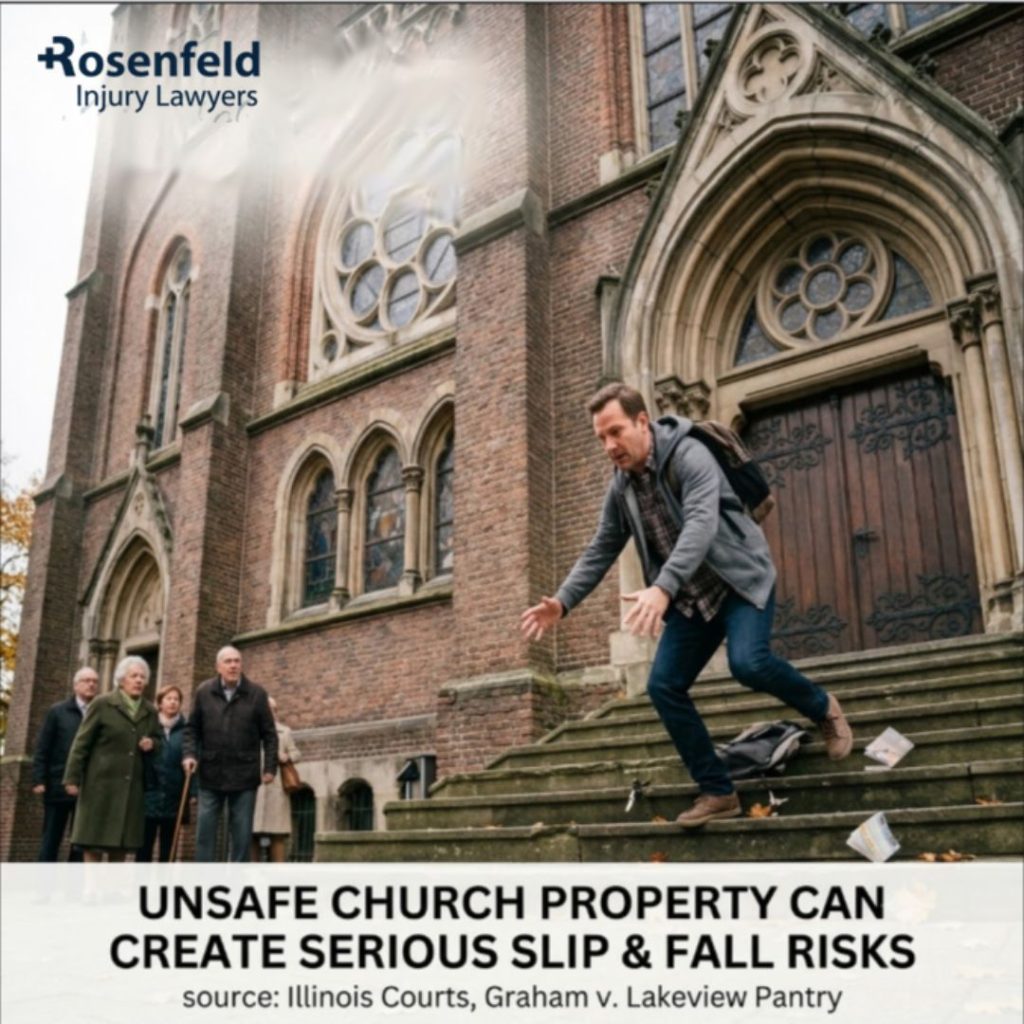
Chicago is dense with neighborhood parishes, and most occupy buildings decades old. Falls cluster around worn front steps, a side entrance with a single low light, a fellowship hall floor mopped before a potluck, or a parking lot shared with a school next door. Historic masonry steps often lack modern handrails or non-slip treads.
We look at where the fall happened, what the surface or lighting condition was, and whether the parish had earlier notice of the problem, sometimes called constructive notice, which often decides a claim’s outcome.
This is the part most people never hear, and it is why so many injured congregants never call anyone. A church or other place of worship may carry a commercial general liability insurance policy that covers certain injuries occurring on its property.
When a claim is filed, the insurance company handles it and pays it. The money does not come from the collection plate or a ministry’s budget. Filing a claim is not suing your congregation. It is a conversation with an insurer designed to respond to situations like yours.
A claim is handled by the insurer, not by the congregation. If you are unsure whether to pursue it, call 312-800-1534 and we will talk it through.
Chicago winters bring early-morning services and holiday gatherings, often before much has been salted or a walkway shoveled. Under Illinois law, property owners are generally not responsible for injuries caused by ice or snow that accumulated naturally, a principle known as the natural accumulation rule.
That protection has limits. Ice from a clogged gutter, broken downspout, or poor roof drainage is an unnatural accumulation, and the owner can be held responsible. The Illinois Snow and Ice Removal Act shields owners for good faith removal efforts, but not for willful or reckless conduct.
Attendees arriving for a 7 a.m. service in poor light face real risk on untreated steps. We review the weather conditions, the maintenance schedule, and the notice the property had before your fall.
Church property ownership in Chicago is not always straightforward. A building may be owned by an individual parish, held under a diocesan structure, or maintained through a separate property trust, and each points to a different responsible party and insurance policy.
This matters because it shapes who receives notice of a claim and which insurer responds. Determining the correct structure is part of the investigation we handle early. You do not need to know this before you call.
Many churches rely on volunteers rather than paid contractors to shovel walkways, salt steps, or clean up after events. The use of volunteers does not necessarily eliminate the property’s obligations to visitors, but it can affect how responsibility and notice are evaluated.
What volunteer maintenance changes is how a claim gets investigated. An attorney pieces together who was responsible for a task that morning and whether the parish knew about gaps in coverage. This changes how a claim gets proven, not whether it exists.
Falls can be particularly consequential for older congregants, who may face greater risks from injuries such as hip fractures or head trauma. A stumble that leaves a younger visitor bruised can leave an older congregant with a fractured hip or a head injury requiring surgery. If a loved one suffered a hip fracture claim after a fall at worship, we can explain how that severity affects claim value.
Older adults are also more likely to arrive early, moving slowly on uneven steps, or relying on an outdated handrail. These are reasons a property owner should anticipate risk rather than assume less responsibility.
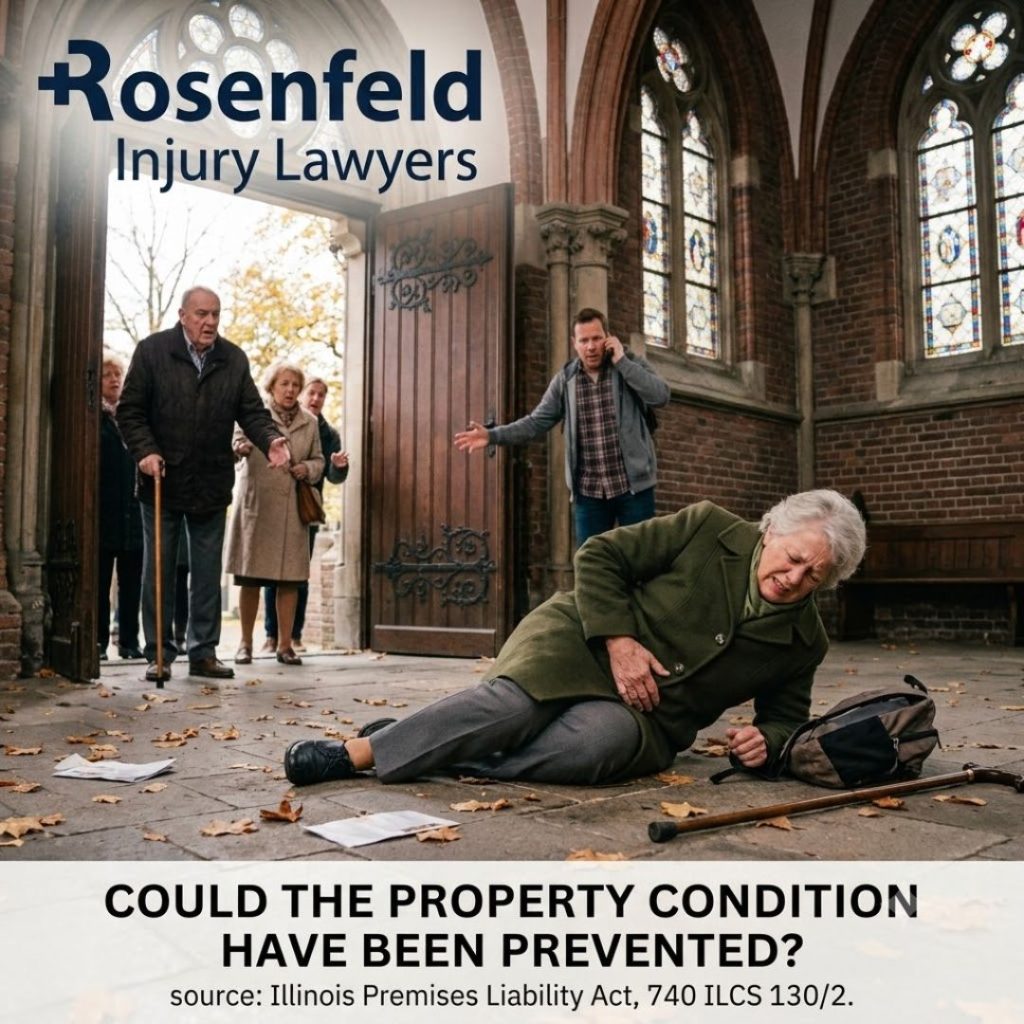
Older Chicago church buildings often include basement fellowship halls, Sunday school classrooms, and back stairwells that were never updated to meet modern lighting standards. These spaces see less traffic than the main sanctuary, so a loose stair tread or burned-out bulb can go unnoticed for weeks.
Stairway falls in these areas are common because visitors are less familiar with the layout and lighting is often inadequate. A fall during coffee hour in a basement stairwell is still a premises liability claim, and a church slip and fall lawyer in Chicago applies the same principles that would apply on the front steps.
If you were hurt at a church, synagogue, mosque, or other place of worship in Chicago, you deserve a clear answer about your options. Illinois’ Premises Liability Act, 740 ILCS 130, generally governs duties owed to people entering property. The specific facts determine whether a church, property owner, or another party may be responsible for your injuries.
Illinois also applies modified comparative fault under 735 ILCS 5/2-1116. If you were no more than 50% at fault, you may still recover damages, although your percentage of fault can reduce recovery. Illinois generally allows two years to file a personal injury claim under 735 ILCS 5/13-202.
We handle these claims with the same care we bring to snow and ice slip and fall claims and parking lot slip and fall settlements cases, while considering the specific facts and circumstances of your fall.
If you were hurt at a place of worship, Slip & Fall Injury Lawyers can help explain who may be responsible, whether the property owner, organization, tenant, or another party may face liability, and what your claim could involve. We will review the circumstances, discuss potential next steps, and answer your questions without pressure. There is no fee unless we win your case. Call 312-800-1534 or reach out today for a free case review and consultation.
Yes, if the church failed to maintain safe conditions and that failure caused your fall. Claims are typically resolved through the insurer, not the congregation.
No. Churches carry liability insurance for injuries like this, and the insurer pays approved claims. The collection plate is not the source of settlement funds.
Using volunteers rather than a paid contractor does not reduce the duty of care owed to visitors. Liability still depends on whether reasonable steps were taken to address the hazard.
It depends on how the property is owned and structured, which varies by location. An attorney can review records to find the correct party.
Generally, two years from the date of the fall, though deadlines can differ for property owned by a government entity. Confirm your deadline early.
 Legally Reviewed By
Attorney Jonathan Rosenfeld
The information on this page has been legally reviewed by Attorney Jonathan Rosenfeld, founder and managing partner of Rosenfeld Injury Lawyers LLC, a Chicago-based personal injury law firm. With decades of experience representing individuals injured in slip and fall accidents and other premises liability cases throughout Chicago, Mr. Rosenfeld is dedicated to protecting the rights of injury victims and helping them pursue the maximum compensation available under the law. His extensive legal knowledge and commitment to client advocacy ensure that the information provided is accurate, reliable, and aligned with current legal standards.